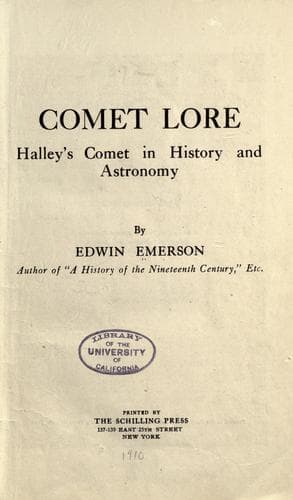
Comet Lore: Halley's Comet in History and AstronomyEmerson, Edwin
History
Comet Lore: Halley's Comet in History and Astronomy
Emerson, Edwin
Comets; Halley's comet
The Roman augurs explained the Comet as a portent of the bloody death
of Emperor Macrinus of Rome, who was murdered by his own soldiers on
the night after the disappearance of the Comet.
141
In this year the Chinese astronomers recorded a Comet in March and
April (the time computed for Halley’s Comet), which they described as
“a star six or seven cubits long and of a bluish-white colour.” The
coming of the Comet was followed by a virulent outbreak of the plague
in China and the Far East, which spread all over the known world. So
virulent was this pestilence that in the City of Naples alone 400,000
people died of the disease.
65-66
Halley’s Comet, according to astronomic calculations, must have made
its reappearance during the winter months of 65-66 A. D. The Chinese
have recorded “two Comets,” one in 65, which was seen for fifty-six
days, and “the other” in February, 66, which remained visible fifty
days.
This was the Comet which St. Peter and Josephus saw over the City of
Jerusalem, before the fall of the Holy City. Josephus wrote of it:
“Amongst other warnings, a Comet, of the kind called Xiphias, because
their tails appear to represent the blade of a sword, was seen above
the doomed city for the space of nearly a whole year.”
Jerusalem was ravaged by pestilence and famine and soon afterward was
stormed by the Roman soldiery led by Titus. The Temple was burned down
and the streets of the Holy City ran with blood. It was the end of
Jerusalem and of the Jews as a free city and people.
B. C. 11
This is the farthest back that the appearances of Halley’s Comet
have been traced in history. For earlier appearances there are no
sufficiently trustworthy computations or records.
Dion Cassius in his “History of Rome” has recorded “a Comet which hung
suspended over the City of Rome just before the death of Agrippa,” who
ruled over the Roman Empire during the absence of Augustus in Greece
and Asia. Agrippa was so universally beloved, and his death was held to
be such a loss to Rome that he was buried with imperial honours in the
tomb intended for Augustus.
The death of Agrippa occurred in the year 12, shortly after the
disappearance of the Comet which Hind has identified with Halley’s.
* * * * *
This completes the record of all the known appearances of Halley’s
Comet. The record fully justifies Chambers’ dictum, that the “Comet
known as Halley’s is by far the most interesting of all the Comets
recorded in history.”
This historic record also appears to justify in no small measure the
popular beliefs of the last two thousand years concerning Comets, as
expressed by Leonard Digges in his book on Prognostics, published 350
years ago:
“Cometes signifie corruption of the ayre. They are
signs of earthquakes, of warres, of changying of
Kyngdomes, great dearth of food, yea a common death
of man and beast from pestilence.”
THE STORY OF EDMUND HALLEY
Public-domain text, read in full here on John Shaqi.
Reviews
Reviews
No reviews yet
Be the first to share your thoughts on this work.
Join the Discussion
Join the discussion
Sign in to leave a comment or review.
Sign InorCreate an account