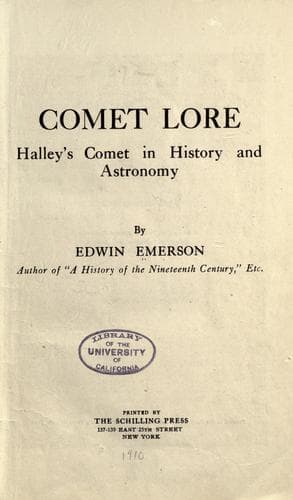
Comet Lore: Halley's Comet in History and AstronomyEmerson, Edwin
History
Comet Lore: Halley's Comet in History and Astronomy
Emerson, Edwin
Comets; Halley's comet
The great French astronomer Lalande considered Halley the greatest
astronomer of his time. This opinion is still held. Halley’s “time”
means the age of Kepler, Sir Isaac Newton, Flamsteed, Hevelius, and
Leibnitz, all of whom achieved first rank in Astronomy.
Halley’s greatest achievement in Astronomy was the discovery that our
solar system was but an atom in immeasurable space whence wandering
stars could be caught within the influence of our Sun, our Earth and
the other Planets swinging around our Sun.
Halley was the first to discover and to prove that the Comets that come
within the vision of man have fixed periods of return. He made this
discovery during the appearance of the great Comet of 1682, which has
since been known by his name.
In his studies of the motions of Comets, of which Halley computed the
orbits of twenty-four, he observed that a Comet of similar phenomena,
recorded by Appian in 1531 and by Kepler in 1607, had swung through the
same orbit as the Comet under his observation in 1682. Halley surmised
from this that these Comets might be one and the same, whose intervals
of return appeared to cover a period of seventy-five or seventy-six
years. Halley’s surmise seemed to be confirmed by the recorded
appearance of similar bright Comets in the years 1456, 1378, and 1301,
the intervals again being seventy-five or seventy-six years.
Halley was deeply imbued with Newton’s new discovery of gravitation,
for the publication of which Halley paid the expenses, so he brought
the principles of Newton’s theory of gravitation to bear on his own new
theory of the motions of Comets. He rightly conjectured that Comets
were drawn to our Sun across the disturbing orbits of our planetary
system, and that the comparatively small differences of one or two
years in the recorded intervals of this one Comet (Halley’s Comet) were
due to the attraction of the larger planets.
During the previous year, 1681, Halley computed that the Comet had
passed near the planet Jupiter, the attraction of which must have had a
considerable influence on the Comet’s motion. Making due allowance for
this disturbing influence of Jupiter, he computed that the Comet would
return to the vicinity of our Sun about the end of 1758 or beginning of
1759.
Halley did not live to see his prediction fulfilled (he died in 1742),
but he wrote shortly before he died: “If this Comet should return
according to our predictions about the year 1758, impartial posterity
will not refuse to acknowledge that this was first discovered by an
Englishman.”
Public-domain text, read in full here on John Shaqi.
Reviews
Reviews
No reviews yet
Be the first to share your thoughts on this work.
Join the Discussion
Join the discussion
Sign in to leave a comment or review.
Sign InorCreate an account