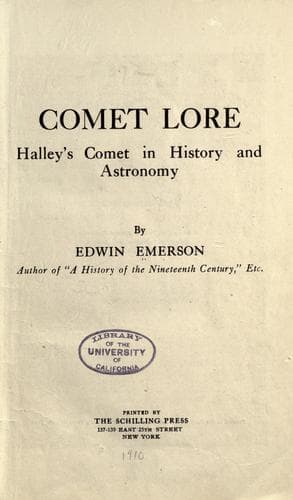
Comet Lore: Halley's Comet in History and AstronomyEmerson, Edwin
History
Comet Lore: Halley's Comet in History and Astronomy
Emerson, Edwin
Comets; Halley's comet
All through the year 1758 the most noted astronomers of Europe were
on the lookout for the return of the predicted Comet. One of these
astronomers, Messier, looked for it through his telescope at the Paris
Observatory every night from sunset to sunrise throughout that whole
year. On Christmas night, 1758, the Comet was first seen by a German
peasant near Dresden, who had heard about the Comet and was looking
for it. He was a man of unusually good eyesight, yet his discovery was
doubted until Messier, nearly a month afterward, at Paris, “picked up”
the Comet with his telescope.
From that time forth this Comet, which returned in 1835, and is
reappearing in this year (1910), has been known as Halley’s Comet.
[Illustration: EDMUND HALLEY.]
Besides this achievement, Halley accomplished many other noteworthy
feats in astronomy, such as his discovery of the proper motions of the
fixed stars; his detection of the “long inequality” of Jupiter and
Saturn, and of the acceleration of the moon’s mean motion; his theory
of variation, including the hypothesis of various magnetic poles, with
his suggestion of the magnetic origin of the aurora borealis; and his
indication of a method still used for determining the solar parallax by
means of the transits of Venus.
On the strength of these achievements, Halley for many years was
elected to serve as secretary to the Royal Society. Commissioned as a
Captain in the Royal Navy, he also commanded a vessel on a long cruise
of exploration, and late in life he was made Astronomer Royal.
Although in his sixty-fourth year, he then undertook to observe the
moon through an entire revolution of her nodes (eighteen years), and
actually carried out his purpose. To appreciate the full significance
of so painstaking an achievement it should be borne in mind that
astronomical observations must be made in a temperature equal to that
of the open air. Observatories cannot be heated because the heat would
impair the accuracy of the instruments.
Great astronomers, like poets, are born, not made. Edmund Halley was
one of these. At the age of seventeen he had already observed the
change in the variations of the compass. At nineteen he was recognized
as an astronomer of reputation, having supplied a new and improved
method of determining the elements of the planetary orbits. His
detection of considerable errors in the tables then in use led him to
the conclusion that a more accurate determination of the places of the
fixed Stars was indispensable to the progress of astronomy. With this
end in view he set out on a voyage to the other side of the globe, St.
Helena, where he undertook the task of making complete new observations
of the entire Southern Hemisphere. Though the Heavens proved clouded
he succeeded within two years in registering three hundred and sixty
stars, a colossal achievement which won for him the title of the
“Southern Tycho.” This was when Halley was barely of age.
Public-domain text, read in full here on John Shaqi.
Reviews
Reviews
No reviews yet
Be the first to share your thoughts on this work.
Join the Discussion
Join the discussion
Sign in to leave a comment or review.
Sign InorCreate an account