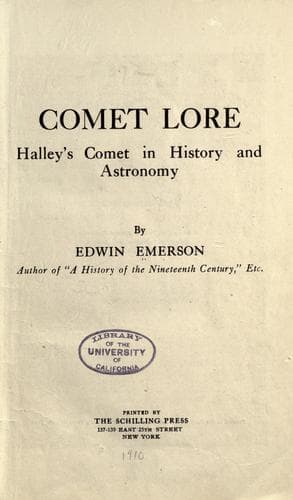
Comet Lore: Halley's Comet in History and AstronomyEmerson, Edwin
History
Comet Lore: Halley's Comet in History and Astronomy
Emerson, Edwin
Comets; Halley's comet
Halley returned to England in November, 1678, and was hailed by his
fellow astronomers as the “Southern Tycho.” He was elected a fellow of
the Royal Society, and by the King’s command the degree of Master of
Arts was conferred upon him by the University of Oxford.
Six months later Halley set out for Dantsic for a personal conference
with Hevelius, the Polish astronomer. Halley wanted to satisfy himself
as to the accuracy of observations claimed by Hevelius without the
aid of a telescope. Halley convinced himself that the errors of the
observations made by Hevelius were less than had been supposed, and did
not exceed a minute of an arc. The two became life-long friends. Halley
proceeded to other cities of Europe where there were observatories. In
Paris he observed with Cassini the great Comet of 1680. This was the
beginning of Halley’s special study of Comets.
Returning to England, the young astronomer married the daughter of
Mr. Tooke, auditor of the Exchequer, with whom he lived harmoniously
until her death, fifty-five years later. The young couple settled at
Islington, where Halley erected an observatory of his own and engaged
in constant lunar observations with a view toward finding a method for
computing longitudes at sea.
Halley’s mind at the same time was busy with the momentous problem of
gravity, upon which Isaac Newton was working then. Independently of
Newton, Halley reached the conclusion that the central force of the
Solar System must decrease inversely as the square of the distance.
Having applied vainly to his fellow astronomers, Hooke and Wren, Halley
in August, 1684, made a special journey to Cambridge to consult Isaac
Newton, who confirmed his conjectures.
Halley and Newton became life-long friends. Halley had Newton elected
to the Royal Society, and when Newton became too poor to pay his
quarterly dues, Halley, through his influence with the leading members
of the Society, had them remitted. It was Halley who encouraged Newton
to put his momentous discovery and elucidation of the forces of gravity
into permanent form in his “Principia,” the first volume of which, “De
Motu,” was presented to the Royal Society at Halley’s suggestion.
In the proceedings of the Royal Society for December, 1684, there is an
entry that “Mr. Halley had lately seen Mr. Newton at Cambridge, who had
told him of a curious treatise ‘De Motu,’ which at Mr. Halley’s desire
he promised to send to the Society to be entered upon their register.
Mr. Halley was desired to put Mr. Newton in mind of his promise for the
securing this invention to himself, till such time as he could be at
leisure to publish it.”
Early in the following year Newton sent his treatise to the Society, to
whom it was read aloud by Halley. This treatise “De Motu” was the germ
of the “Principia” and was intended to be a short account of what the
greater work was to embrace.
Public-domain text, read in full here on John Shaqi.
Reviews
Reviews
No reviews yet
Be the first to share your thoughts on this work.
Join the Discussion
Join the discussion
Sign in to leave a comment or review.
Sign InorCreate an account