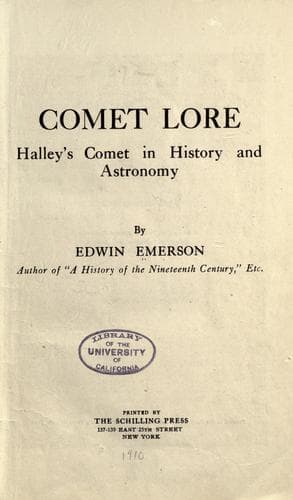
Comet Lore: Halley's Comet in History and AstronomyEmerson, Edwin
History
Comet Lore: Halley's Comet in History and Astronomy
Emerson, Edwin
Comets; Halley's comet
Besides being an astronomer of the first class, Halley was also a good
navigator. In 1698 he was commissioned a captain in the Royal Navy
and was put in command of the King’s ship, “The Paramour Pink.” With
this vessel he set out on a long cruise to the Pacific for the purpose
of making observations on the laws which govern magnetic variations.
This task he accomplished in a voyage which lasted two years and
extended to the fifty-second degree of southern latitude, when the ice
compelled him to turn back. On the return voyage his crew mutinied and
his lieutenant sided with the mutineers. Halley quelled the mutiny by
sheer force of personality, and returning to England got rid of his
lieutenant. The results of his voyage were published in his “General
Chart of the Variation of the Compass” in 1701. Immediately afterwards
Halley set out on another King’s ship and executed by royal command
a careful survey of the tides and coasts of the British Channel, an
elaborate chart of which he published in 1702.
Next Halley was sent by the King to Dalmatia, for the purpose of
selecting and fortifying the port of Trieste.
On Halley’s return to England, he was made Savilian professor of
geometry at Oxford, and received an honorary doctor’s degree. He
filled two terms of eight years each as secretary to the Royal
Society, and early in 1720 he succeeded Flamsteed as Astronomer Royal.
He died on January 14, 1742, at the age of eighty-five in the full
possession of his faculties, the foremost astronomer of the day and a
man universally beloved and respected. His gravestone stands at the
Greenwich Observatory.
Halley’s works fill several shelves in the library of the Royal
Society. His fame is kept green by the periodical return of the
wandering star known by his name.
WHAT ARE COMETS?
The modern answer to the question “What are Comets made of?” is this:
Probably the heads are a mixture of solid and gaseous matter. The tails
are gaseous—the result of the volatilisation of the solid matter of
the heads.
The spectroscope shows that gases appear to be a constituent of all
Comets. The spectra of Comets are very similar to those of a Bunsen
flame. Recent spectroscopic photographs have revealed the presence of
hydrocarbons, nitro-carbons, of cyanogen and of the vapours of sodium,
iron and other metals.
The connection between Comets and Meteors implies the presence in
Comets of solid matter. A modern theory, voiced by Schiaparelli, is
that meteor showers are broken up Comets.
The tails of Comets appear to be composed of luminous gases ejected
from the head of the Comet through a solar force held to be “Light
Pressure,” which causes these tails to shoot off and disperse into
space at the rate of 865,000 miles an hour.
The length of some Comets’ tails has been estimated at 125,000,000
miles, while the Comets’ heads themselves are generally much larger in
size than our Earth. Halley’s Comet is more than ten-fold the size of
our Earth.
Public-domain text, read in full here on John Shaqi.
Reviews
Reviews
No reviews yet
Be the first to share your thoughts on this work.
Join the Discussion
Join the discussion
Sign in to leave a comment or review.
Sign InorCreate an account