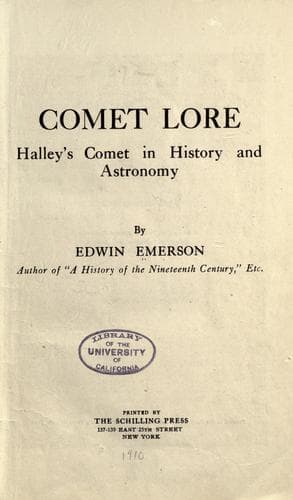
Comet Lore: Halley's Comet in History and AstronomyEmerson, Edwin
History
Comet Lore: Halley's Comet in History and Astronomy
Emerson, Edwin
Comets; Halley's comet
Halley began to do some mathematical figuring, and decided that, if a
Comet’s mass were comparable with that of the Earth, our year would
have been changed in length because the Earth’s orbit would have been
altered. He also speculated what would happen to the Earth, and reached
this conclusion:
“If so large a body with so rapid a motion were to
strike the Earth—a thing by no means impossible—the
shock might reduce this beautiful world to its
original chaos.”
Halley even thought it probable that the Earth had actually been struck
by a Comet at some remote period, struck obliquely, moreover, so that
the axis of rotation had been changed. Thus he was led to infer that
possibly the North Pole had once been at a point near Hudson’s Bay, and
that the rigour of North America’s climate might thus be accounted for.
The seed which was thus sown by Halley has borne fruit. In Halley’s
own time, learned men were brooding over the ultimate destruction of
the Earth by collision with a Comet.
Dr. Whiston, who succeeded Newton at Cambridge in the Lucasian chair of
mathematics, was sure that a Comet caused the Deluge, and went so far
as to prophesy that a Comet, as it passed us on its outward course from
the Sun, would ultimately bring about a “General Conflagration,” and
thus envelope the Earth in flames.
One century after Halley, the French astronomer Laplace, whose
mathematical attainments were surpassed only by those of Newton,
applied his brilliant mind to the possibility of a collision with a
Comet, and arrived at this conclusion:
“The seas would abandon their ancient beds and rush
towards the new equator, drowning in one universal
deluge the greater part of the human race.... We see,
then, in effect, why the ocean has receded from the
high lands upon which we find incontestable marks of
its sojourn; we see how the animals and plants of the
south have been able to exist in the climate of the
north, where their remains and imprints have been
discovered.”
The famous French mathematician Lalande showed that if a Comet as heavy
as the Earth were to come within six times the distance of the Moon,
it would exert such a powerful attraction upon the waters of the globe
as to pull up a tidal wave 13,000 feet above the ordinary sea-level
and inundate the continents Every European mountain would be submerged
except Mt. Blanc, and only the inhabitants of the Rockies, the Andes
and the Himalayas would escape death.
Public-domain text, read in full here on John Shaqi.
Reviews
Reviews
No reviews yet
Be the first to share your thoughts on this work.
Join the Discussion
Join the discussion
Sign in to leave a comment or review.
Sign InorCreate an account