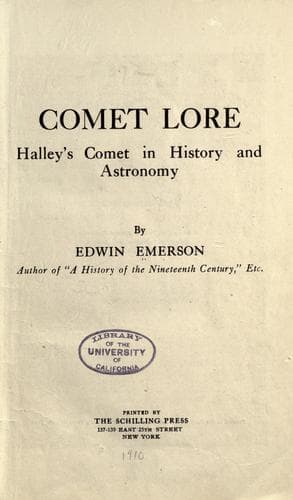
Comet Lore: Halley's Comet in History and AstronomyEmerson, Edwin
History
Comet Lore: Halley's Comet in History and Astronomy
Emerson, Edwin
Comets; Halley's comet
The woe of one Comet (Halley’s Comet of 1456), which had the shape of
a Turkish scimitar, so the Arab soothsayers foretold, would be turned
against their enemies. This was the same Comet which brought such fear
to the hearts of Pope Calixtus III. and all his Christian followers.
Thus it can be seen that Comets have been held to foretell disaster on
one side, and victory on the other.
The Comets which conquerors hailed as their guiding stars, have meant
war and bloodshed and disaster to those whom they came to conquer.
The same Comets which shone upon the birth of mighty rulers, have
blazed in warning of their death.
Julius Caesar, who was born under a Comet, saw his bloody end foretold
by another Comet.
Therefore, Shakespeare in his play “Julius Caesar,” makes Calpurnia say
to Caesar:
“When beggars die, there are no Comets seen;
The Heavens themselves blaze forth the death of princes.”
On the night of Caesar’s assassination, when the Comet was seen blazing
at its brightest, the Romans said that it had come to bear away the
great soul of the murdered Caesar.
At the death of Nero, the Roman Emperor, who persecuted the Christians,
a Comet blazed forth again. The Roman historian Suetonius, who wrote
the Life of Emperor Nero, thus described this Comet:
“A blazing star, which was commonly held to portend
destruction to Kings and Princes, reappeared above
the horizon several nights in succession.”
Another great Comet (Halley’s again) reappeared when Attila, the King
of the Huns, the “Scourge of God,” was overthrown in the greatest
battle of Christendom on the Catalaunian fields.
Claudius, a Roman writer of that period, then stated that “a Comet was
never seen in the Heavens without implying some dreadful event.”
This has ever been the belief of all the great poets of olden time.
Homer, the greatest poet of Ancient Greece, a thousand years before the
birth of Christ, sang of:
“The red star, that from his flaming hair
Shakes down diseases, pestilence and war.”
Let it be explained here that the word Comet in Greek means
“long-haired,” from _kome_,—hair.
Virgil, the greatest Roman poet, sang of “the baleful glare of bloody
Comets,” and again, of “dreadful Comets blazing in the sky.”
Tasso, the greatest of Italian poets after Dante, sang thus of Comets
in his “Jerusalem Delivered”:
“Qual con le chiome sanguinose horrende
Splender Cometa suol per l’aria adusta,
Che i regni muta, e i feri morbi adduce,
Ai purpurei tiranni infausta luce.”
—_Gerusalemme Liberata, Canto VII., Stanza 52._
Rendered thus by Wiffen into English:
“As with its bloody locks let loose in air
Horribly bright, the Comet shows whose shine
Plagues the parched World, whose looks the Nations scare,
Before whose face States change, and Powers decline,
To purple Tyrants all, an inauspicious sign.”
Public-domain text, read in full here on John Shaqi.
Reviews
Reviews
No reviews yet
Be the first to share your thoughts on this work.
Join the Discussion
Join the discussion
Sign in to leave a comment or review.
Sign InorCreate an account