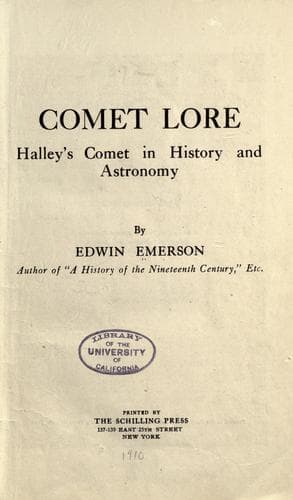
Comet Lore: Halley's Comet in History and AstronomyEmerson, Edwin
History
Comet Lore: Halley's Comet in History and Astronomy
Emerson, Edwin
Comets; Halley's comet
The great English poets, on their part, have lifted up their voices to
sing of the dire effects of Comets.
Shakespeare, the greatest of them all, abounds in allusions to these
dread wandering stars.
Thus he makes Horatio in the first scene of “Hamlet” speak with awe of:
“Stars with trains of fire and dews of blood;
* * * * *
And even the like precurse of fierce events,
As harbingers preceding still the fates
And prologue to the omen coming on.”
More briefly Shakespeare in his “Henry VI.” refers to:
“A Comet of revenge
A prophet to the fall of all our foes”;
and again, in “The Taming of the Shrew” to:
“Some Comet or unusual prodigy.”
Spenser in his “Faerie Queene” sings of a woman’s hair loosely
dispersed in the wind:
“All as a blazing starre doth farre outcast
His heavy beames, and flaming lockes dispredd,
At sight whereof the people stand aghast;
But the sage Wizzard telles, as he has redd,
That it importunes death and doleful drearyhedd.”
John Milton, besides likening Satan to a Comet, as before quoted, also
showed that he shared in the belief that the flaming swords mentioned
in Holy Writ were Comets:
“High in front advanced
The brandish’d sword of God before them blazed
Fierce as a Comet.”
The poet Young, in his “Night Thoughts,” aptly writes of the Comet:
“Hast thou ne’er seen the Comet’s flaming light?
Th’ illustrious stranger passing, terror sheds
On gazing Nations, from his fiery train.”
The poets of other nations have written of Comets in like vein. There
is an old German rhyme, sung by German school children even to-day,
which has been put into English by Dr. Andrew D. White in his “History
of the Doctrine of Comets”:
“Eight things there be a Comet brings,
When it on high doth horrid range;
Wind, Famine, Plague, and Death to Kings,
War, Earthquake, Floods and Direful Change.”
This little rhyme was originally put forth for German school children
by two Protestant preachers of Basle, Switzerland, at the time of the
great Comet of 1618, which heralded the outbreak of the great “Thirty
Years’ War.”
These Protestant ministers got their belief in Comets and their evil
influence upon mankind not from the Church of Rome, but from the
Bible teachings of such great Protestant reformers as Martin Luther,
Melanchthon, Zwingli, Calvin, John Knox of Scotland, Bishop Jeremy
Taylor and John Howe, the great Nonconformist divine.
Martin Luther preached in one of his Advent sermons:
“The heathen write that the Comet may arise from
natural causes; but God creates not one that does not
foretoken a sure calamity.”
Luther’s friend, Melanchthon, in a letter, declared Comets to be
“heralds of Heaven’s wrath.”
Zwingli, in 1531, declared that the great Comet of that year (Halley’s
Comet) was sent by God to betoken calamity.
Public-domain text, read in full here on John Shaqi.
Reviews
Reviews
No reviews yet
Be the first to share your thoughts on this work.
Join the Discussion
Join the discussion
Sign in to leave a comment or review.
Sign InorCreate an account