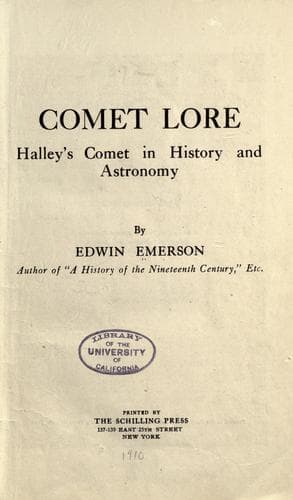
Comet Lore: Halley's Comet in History and AstronomyEmerson, Edwin
History
Comet Lore: Halley's Comet in History and Astronomy
Emerson, Edwin
Comets; Halley's comet
“Every night the Comet blazed in the Heavens, and we
all asked ourselves: What misfortune does it bring?
Then the enemy came, and our sacred city was put
to the torch. Our convent, together with all other
cloisters, monasteries and churches, was burned to
the ground.”
Many other writers of the time who saw the great Comets that blazoned
Napoleon’s destructive wars have recorded how they were universally
taken as omens of the great conqueror’s bloody trail.
Napoleon himself gloried in this dread omen and hailed the Comet as his
“guiding star.”
All this has been fully set forth by the famous French astronomer
Messier, a latter-day observer of Halley’s Comet, who wrote a special
book on “The Wonderful Comet which appeared at the Birth of Napoleon
the Great.”
As for the many Comets that have blazed down upon other great
conquerors and other bloody wars, before the comparatively recent
Comets of the American Civil War and the Napoleonic Wars, they are all
set down in a special History of Comets.
In this great work, entitled “A History of All Comets,” the Latin
scholar Lubienitius has pointed out all the calamities and dire events
which attended the appearance of each and every Comet recorded in
history.
THE EFFECTS OF COMETS ON MAN
Some thinkers have pointed out that there has often been a direct
connection between the feelings produced in the human soul by the
appearance of a Comet and the human deeds of violence or the human
epidemics and excessive mortality following the widespread terror
produced by Comets.
Only this year (1910) the appearance of Inness’ Comet over Mexico
caused a panic-stricken holy pilgrimage to the Shrine of Talpa. In
China, too, it caused terror, resulting in Christian massacres.
Hence, also, several Jewish massacres inspired by Comets in the past
and hence also so many terrifying plagues connected with Comets.
Thus Ambroise Paré, the “Father of French Surgery,” who flourished
in the sixteenth century, has recorded the effect produced upon his
contemporaries by the Comet of 1528.
“This Comet was so horrible,” wrote Dr. Paré, “so frightful, and it
produced such great terror among the common people, that many died of
fear and many others fell sick.”
Dr. Paré himself appears to have come under the influence of this fear,
judging from his awestruck description of the appearance of this Comet:
“It appeared to be of excessive length; and was of
the colour of blood. At the summit of it was seen the
figure of a bent arm, holding in its hand a great
sword as if about to strike.
“At the end of the point there were three stars.
On both sides of the rays of this Comet were seen
a great number of axes, knives, and blood-coloured
swords, among which were a great number of hideous
human faces with beards and bristling hair.”
Hannibal committed suicide on account of a Comet. So did Mithridates.
So did one Toma, in Hungary, only this year.
Public-domain text, read in full here on John Shaqi.
Reviews
Reviews
No reviews yet
Be the first to share your thoughts on this work.
Join the Discussion
Join the discussion
Sign in to leave a comment or review.
Sign InorCreate an account