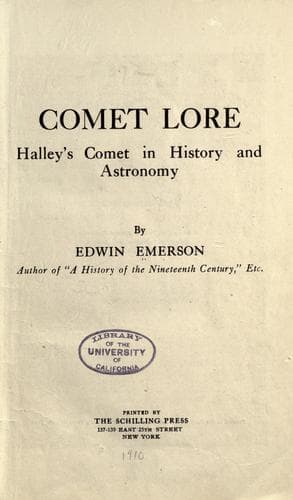
Comet Lore: Halley's Comet in History and AstronomyEmerson, Edwin
History
Comet Lore: Halley's Comet in History and Astronomy
Emerson, Edwin
Comets; Halley's comet
John Knox, preaching in his Scottish kirk at Edinboro, declared that he
saw in Comets tokens of the wrath of Heaven.
The great divines of the Church of England,—from Cranmer, Bishop
Latimer, Archbishops Spottiswoode and Bramhall, Bishop Jeremy Taylor,
down to our own times, clearly preached the doctrine that Comets must
be taken as tokens from Heaven.
Thus the Comet of 1572 was pointed out from the pulpits of England
and Scotland as a token of Heaven’s wrath and warning at the St.
Bartholomew Massacre on the night of August 24, 1572, when thirty
thousand Huguenots were murdered in the streets of Paris and elsewhere
in France.
Across the sea, in the new Commonwealth of Massachusetts, the great
New England divine and President of Harvard College, Increase Mather,
on the apparition of the great Comet now known as Halley’s, in 1682,
preached on “Heaven’s Wrath Alarm to the World—wherein is shown that
fearful sights and signs in the Heavens are the presages of great
calamities at hand.”
Increase Mather preached on the text taken from the Book of Revelation:
“And the third Angel sounded, and there fell a great Star burning as a
Torch, ... and behold the Third Woe cometh quickly.”
In this sermon the great preacher told of the Roman Emperor Vespasian,
who, when warned of the omen of a Comet, made fun of it, and then died
miserably.
So Mather preached: “For the Lord hath fired his beacon in the Heavens
among the stars of God there. The fearful sign is not yet out of
sight.... Do we not see the sword blazing over us?... Doth God threaten
our very Heavens? O pray unto Him, that he would not take away stars
and send Comets to succeed them!”
[Illustration: THE TERROR OF THE COMET OF 1531. FROM AN OLD NUREMBERG
WOOD-CUT.]
The profound Russian thinker Tolstoy, in his great book “War and
Peace,” has written of the flaming Comet of 1811. This was the famous
“Comet of Napoleon,” which blazed over Western Europe when Napoleon was
gathering his grand army for its disastrous march into Russia and to
Moscow.
At Moscow, the ancient capital of Russia, this Comet was observed by
anxious thousands. One night there was this talk between a novice nun
and the Abbess of her Convent. On their way to vesper service one
evening in Moscow the nun suddenly beheld the Comet for the first time
and asked: “What is that star?”
The Abbess answered: “It is not a star. It is a Comet.”
“But what is a Comet?” asked the young nun. “I have never heard that
word.”
The Abbess then answered: “Comets are signs in Heaven, which God sends
before misfortunes.”
Shortly after this the bloody battle of Borodino was fought, and
Napoleon, with his army, appeared before the gates of Moscow. The
hundred-towered city was abandoned by the Russians and was given over
to the flames.
Years afterward this same nun thus told her story, as printed in the
“Revue des Deux Mondes”:
Public-domain text, read in full here on John Shaqi.
Reviews
Reviews
No reviews yet
Be the first to share your thoughts on this work.
Join the Discussion
Join the discussion
Sign in to leave a comment or review.
Sign InorCreate an account