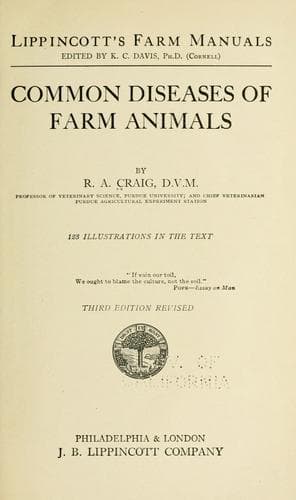
Common Diseases of Farm AnimalsCraig, Robert Alexander
Science
Common Diseases of Farm Animals
Craig, Robert Alexander
Veterinary medicine
_The treatment_ consists in removing the cause, and giving the flock a
tonic mixture in the feed. The following mixture may be used: powdered
gentian and powdered ginger, eight ounces of each, Glauber's salts four
ounces, and sulfate of iron two ounces. One ounce of the above mixture may
be given in ten pounds of feed.
WHITE DIARRHOEA OF YOUNG CHICKENS.--White diarrhoea is of the greatest
economic importance to the poultryman. The loss of chicks from this disease
is greater than the combined loss resulting from all other diseases. It is
stated by some authors that not less than fifty per cent of the chickens
hatched die from white diarrhoea.
Such a heavy death-rate as is attributed to this disease can not result
from improper methods of handling and insanitary conditions. Before it was
proven that white diarrhoea was caused by specific germs, a great deal of
emphasis was placed on such causes as debilitated breeding stock, improper
incubation, poorly ventilated, overcrowded brooders, too high or too low
temperatures and filth. Such conditions are important predisposing factors,
and may, in isolated cases, result in serious intestinal disorders.
_The microorganisms causing_ this disease belong to both the plant and
animal kingdoms. Infection usually occurs within a day or two following
hatching. Chicks two or three weeks of age seldom develop the acute form of
the disease. Incubator chicks are the most susceptible to the disorder.
_The following symptoms occur_: The chicks present a droopy, sleepy
appearance; the eyes are closed, and the chicks huddle together and peep
much of the time; the whitish intestinal discharge is noticed adhering to
the fluff near the margins of the vent, and the young bird is very weak;
death may occur within the first few days. After the first two weeks the
disease becomes less acute. In the highly acute form the chicks die without
showing the usual train of symptoms.
It is very easy to differentiate between the infectious and the
non-infectious diarrhoea. In the latter, the percentage of chicks affected
is small and the disease responds to treatment more readily than does the
infectious form. The death-rate in the latter form is about eighty per
cent.
_The treatment_ of diarrhoea in chicks from any cause is preventive. This
consists in removing the cause. No person can successfully handle poultry
if he does not give the necessary attention to sanitation. Poultry houses,
runs, watering fountains and feeding places must be constantly cleaned and
disinfected. The degree of attention necessary depends on the surroundings,
the crowded condition of the poultry houses and runs, and the presence of
disease in the flock. If disease is present, we can not clean and disinfect
the quarters too often. The attendant can not overlook details in handling
the incubator or brooder and feeding the chicks and be uniformly
successful.
Public-domain text, read in full here on John Shaqi.
Reviews
Reviews
No reviews yet
Be the first to share your thoughts on this work.
Join the Discussion
Join the discussion
Sign in to leave a comment or review.
Sign InorCreate an account