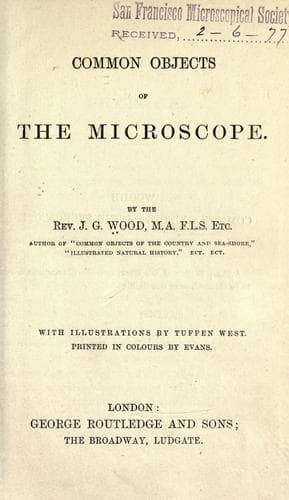
Common objects of the microscopeWood, J. G. (John George)
Science
Common objects of the microscope
Wood, J. G. (John George)
Microscopes; Microscopy
A variety of instruments has been invented for the same purpose, of
which Beck’s parallel compressorium may be mentioned as the most
efficient, though it is somewhat complicated, and consequently
expensive, costing about twenty-five shillings.
A few glass slips and cover-glasses will also be required. The latter
had better be those known as “No. 2,” since the beginner will find it
almost impossible to clean the thinner ones satisfactorily without
a large percentage of fractures. The safest way is to boil the thin
glass circles in dilute nitric acid (half acid, half water) for a
few minutes, wash well in several waters, first tap-water and then
distilled, and finally to place the covers in methylated spirit. When
required for use, the spirit may be burnt off by applying a light, the
cover-glass, held in a pair of forceps, being in no way injured by the
process.
In addition to the glass slides, the observer will find it advisable to
be provided with a few glass troughs, of various thicknesses, in which
portions of water-plants, having organisms attached to them, may be
examined. Confined in the live-box, many of the organisms ordinarily
found under such circumstances can rarely be induced to unfold their
beauties, whilst in the comparative freedom of the trough they do so
readily. The troughs may be purchased, or may be made of any desired
shape or size by cutting strips of glass of a thickness corresponding
to the depth desired, cementing these to a glass slide somewhat larger
than the ordinary one, and cementing over the frame so formed a piece
of thin glass, No. 3; the best material to use as cement being marine
glue of the best quality, or, failing this, Prout’s elastic glue, which
is much cheaper, but also less satisfactory. The glass surface must
be made, in either case, sufficiently hot to ensure thorough adhesion
of the cement, as the use of any solvent entails long waiting, and
considerable risk of poisoning the organisms. A useful practical hint
in the use of these troughs is that the corners, at the top, should be
greased slightly, otherwise the water finds its way out by capillary
attraction, to the detriment of the stage of the microscope.
Of optical accessories, the bull’s-eye is almost the most valuable. So
much may be effected by its means alone, in practised hands, that it is
well worth the while of the beginner to master its use thoroughly, and
the methods of doing so will be explained in the succeeding chapter.
The substage condenser, too, even in its most simple form, is an
invaluable adjunct, even though it be only a hemisphere of glass,
half an inch or so in diameter, mounted in a rough sliding jacket to
fit underneath the stage. Such an instrument, properly fitted, will
cost about fifteen shillings, but the ingenious worker will easily
extemporise one for himself.
[Illustration: Fig. 11.]
Public-domain text, read in full here on John Shaqi.
Reviews
Reviews
No reviews yet
Be the first to share your thoughts on this work.
Join the Discussion
Join the discussion
Sign in to leave a comment or review.
Sign InorCreate an account