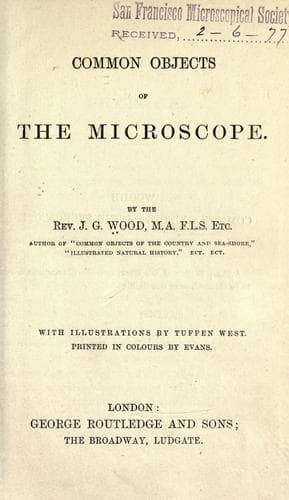
Common objects of the microscopeWood, J. G. (John George)
Science
Common objects of the microscope
Wood, J. G. (John George)
Microscopes; Microscopy
As to the tools required, they are neither numerous nor expensive.
Fine-pointed but strong forceps (Fig. 9, _c_), curved and straight;
a couple of pairs of scissors, one strong and straight, the other
more delicate, and having curved blades, and a few needles of various
thicknesses and curves, are the chief ones. The latter may be made by
inserting ordinary needles, for three-fourths of their length, into
sticks of straight-grained deal (ordinary firewood answers best), and
thereafter bending them as required. A better plan, however, is to be
provided with a few of the needle-holders shown in Fig. 9, _b_. These
are very simple and inexpensive, and in them broken needles are readily
replaced by others. Dipping-tubes, such as are shown in Fig. 12, will
also be extremely useful for many purposes. These are very easily made
by heating the centre of a piece of soft glass tubing of the required
size, and, when it is quite red-hot, drawing the ends apart. The fine
tube in the centre should now be divided by scratching it with a fine
triangular file, and the scratch may of course be made at such a
point as to afford a tube of the required fineness. The edges should
be smoothed by holding them in the flame until they just run (not
melt, or the tube will close). These tubes can often be made to supply
the place of a glass syringe. They may be used either for sucking up
fluid or for transferring it, placing the finger over the wide end,
allowing the tube to fill by displacement of air, and then re-closing
it with the finger. This last method is especially useful for
transferring small objects from one receptacle to another. In speaking
of the dissection of objects, it should have been mentioned that the
microscope itself may, under careful handling, be made to serve very
well, only, as the image is reversed, it is almost impossible to work
without using a prism to re-erect the image. Such a prism is shown in
Fig. 13. The microscope is placed vertically, and the observer, looking
straight into the prism, sees all the parts of the image in their
natural positions. This appliance is extremely useful for the purpose
of selecting small objects, and arranging them on slides in any desired
manner. A few words may be added as to the reproduction of the images
of objects.
[Illustration: Fig. 13.]
Public-domain text, read in full here on John Shaqi.
Reviews
Reviews
No reviews yet
Be the first to share your thoughts on this work.
Join the Discussion
Join the discussion
Sign in to leave a comment or review.
Sign InorCreate an account