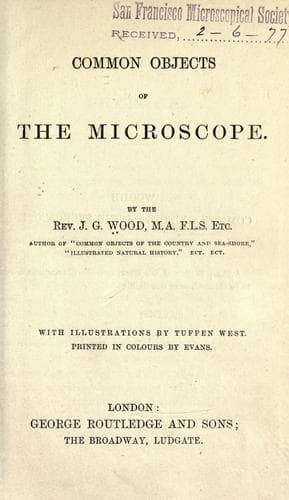
Common objects of the microscopeWood, J. G. (John George)
Science
Common objects of the microscope
Wood, J. G. (John George)
Microscopes; Microscopy
The opportunities for discovery and original work, which are afforded
by all alike, will be more readily appreciated and utilised by
adopting such a plan than by a general and purposeless distribution of
effort. To mention one or two. The student of the fascinating field of
pond-life will find new organisms awaiting description by the hundred,
and of the old ones, life-histories to make out; if he be attracted
rather to the vegetable inhabitants of the same realm, the diatoms will
furnish him with the opportunity of studying, and perhaps solving,
the enigma of their spontaneous movement, and of watching their
development. The smaller fungi, and indeed the larger ones too, will
amply repay the closest and most laborious study of their habits of
life and processes of development. Since the first edition of this work
was published, the whole subject has been practically revolutionised,
and more remains to be done than has yet been accomplished.
In short, there is scarcely an organism, even of those best known
and most studied, which is so completely exhausted that persevering
investigation would reveal nothing new concerning it.
There can be little doubt but that if any worker, with moderate
instrumental means, but with an observant mind, were to set
determinately to work at the study of the commonest weed or the most
familiar insect, he, or she, would by patient labour accomplish work
which would not only be of value to science, but would redound to the
credit of the worker.
Something like finality appears to have been reached, at least for the
present, in the development of the microscope; and whilst it is beyond
the scope of this work to treat of the refined and costly apparatus
which is essential to useful work in certain departments of research,
the result has, on the whole, been highly favourable to the worker of
moderate means and ambitions, since lenses are now accessible, at the
cost of a few shillings, comparatively speaking, which could not have
been purchased at all when this work first appeared. It is with such
appliances that we have here to deal. The worker whose finances are
restricted must be contented to extemporise for himself many pieces
of apparatus, and will find pleasure and occupation in doing so. And
let him remember, for his encouragement, that many such home-made
appliances will fulfil their purpose quite as well as the imposing
paraphernalia of glittering brass and glass which decorates the table
of the wealthy amateur. It is not the man who possesses the best or
most costly apparatus, but the one who best understands the use of that
which he possesses, that will make the most successful microscopist. A
good observer will discover, with only the aid of a pocket-magnifier,
secrets of Nature which have escaped the notice of a whole army of
dilettante microscopists, in spite of the advantages which, as regards
instruments, the latter may enjoy.
Public-domain text, read in full here on John Shaqi.
Reviews
Reviews
No reviews yet
Be the first to share your thoughts on this work.
Join the Discussion
Join the discussion
Sign in to leave a comment or review.
Sign InorCreate an account