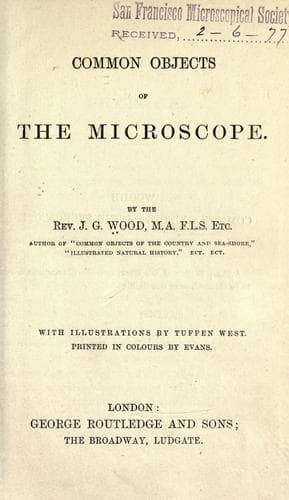
Common objects of the microscopeWood, J. G. (John George)
Science
Common objects of the microscope
Wood, J. G. (John George)
Microscopes; Microscopy
It is for those who desire to be of the former class that this book
is written, and in the course of the following pages instances will
be given in which the exercise of a small amount of ingenuity and the
expenditure of a few pence will be found equivalent to the purchase of
costly and complicated apparatus.
An enormous amount of valuable work was done in the earliest days
of microscopy, when the best apparatus available was a single lens,
composed of the bead formed by fusing the drawn-out end of a rod
of glass. Inserted into a plate of metal, or a piece of card, such
a primitive instrument was capable of affording a large amount of
information. Similar instruments are to be purchased for a few pence
at the present day, and are not without their use for purposes of
immediate examination of material. A very common form is a glass
marble, ground flat on one side, and mounted in a tube. The material to
be examined is placed upon the flat side, and is seen magnified to an
extent inversely proportional to the diameter of the sphere of glass.
CHAPTER II
Elementary Principles of Optics--Simple Microscopes--Compound
Microscope--Accessory Apparatus--Cover-glasses--Troughs--
Condensers--Dissection--Dipping-tubes--Drawing--Measurement.
Before proceeding to deal with the microscope itself, it may be useful
to give a short summary of the optical laws upon which its working
depends.
To go into the minutiæ of the matter here would be out of place, but it
will be found very helpful, especially in the matter of illumination,
to acquire some knowledge of, and facility in applying, these
elementary principles. We shall confine our remarks to convex lenses,
as being the form to which all the combinations in the microscope may
be ultimately reduced.
Every convex lens has one “principal” focus, and an infinite number
of “conjugate” foci. The principal focus is the distance at which it
brings together in one point the rays which fall upon it parallel to
its axis, as shown in Fig. 1, in which _A_ is the axis of the lens _L_,
and the rays _RR_ are brought together in the principal focus _P_. Thus
a ready means of finding the focal length of any lens is to see at what
distance it forms an image of the sun, or of any other distant object,
upon a screen, such as a piece of smooth white cardboard. In the figure
this distance will be _PL_. Conversely, if the source of light be at
_P_, a parallel beam of light will be emitted from the lens.
[Illustration: Fig. 1.]
Public-domain text, read in full here on John Shaqi.
Reviews
Reviews
No reviews yet
Be the first to share your thoughts on this work.
Join the Discussion
Join the discussion
Sign in to leave a comment or review.
Sign InorCreate an account