=UNIVERSITY OF CALIFORNIA PUBLICATIONS=
COLLEGE OF AGRICULTURE
AGRICULTURAL EXPERIMENT STATION
BERKELEY, CALIFORNIA
COMPARISON OF WOODS FOR BUTTER BOXES
_By_ G. D. TURNBOW
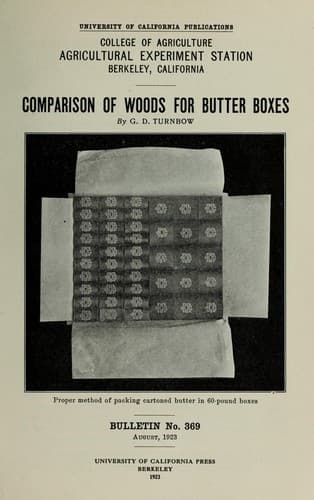
[Illustration: Proper method of packing cartoned butter in 60-pound boxes]
BULLETIN No. 369
August, 1923
UNIVERSITY OF CALIFORNIA PRESS
BERKELEY
1923
COMPARISON OF WOODS FOR BUTTER BOXES
BY
G. D. TURNBOW
Butter boxes used in shipping and storing butter in California, are
usually made of spruce which is largely shipped in from other states
particularly from Washington and Oregon.
With the recent war, however, there came an acute shortage of spruce
on the Pacific Coast with a corresponding increase in price. The
commercial manufacturers did some work in an attempt to find a
substitute for spruce, but the trade did not readily accept a change.
There was a demand from both the lumber and the butter interests for
investigation to find a suitable substitute for spruce.
The production of spruce is somewhat limited in California, but there
is an abundance of white fir and a limited amount of cottonwood
available. However, the creamerymen have not used white fir and
cottonwood to any extent for butter containers, on account of the
belief that these materials would impart a wood flavor to the butter.
Inasmuch as nearly all of the butter made in this State is shipped or
stored in wooden containers, the use of white fir or cottonwood, would
mean first, a material saving to the butter manufacturers in marketing
expense, and second, an opportunity for the lumber interests to use a
large amount of raw material already available in California, which
heretofore had been of little commercial value or use.
BUTTER ABSORBS ODOR
The volatile fats in butter have the property of absorbing odors,
which often results in an undesirable flavor. Great care then must be
exercised in keeping butter from coming in contact with materials that
will impart a foreign flavor. Butter need be exposed to foreign odors
only a short length of time before the flavor is permanently affected.
Experiments[A] were conducted, therefore, to determine whether white
fir or cottonwood would impart a flavor to the butter and also to
determine the possibility of storing butter in cubes and marketing it
in 60-pound cases when these woods were used.
[A] This experiment was suggested by Mr. M. B. Pratt, Deputy State
Forester. Through his coöperation, all box material was furnished by
the Swayne Lumber Company of Oroville and the Capitol Box Factory of
Sacramento.
CUBE BUTTER IN COLD STORAGE
Public-domain text, read in full here on John Shaqi.
Reviews
Reviews
No reviews yet
Be the first to share your thoughts on this work.
Join the Discussion
Join the discussion
Sign in to leave a comment or review.
Sign InorCreate an account