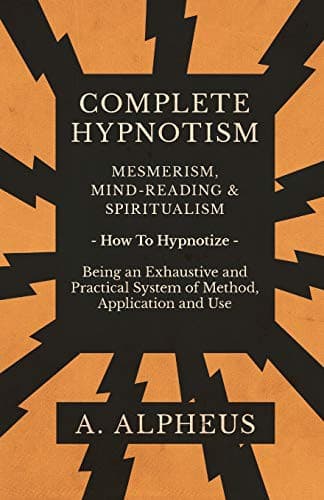
Complete Hypnotism, Mesmerism, Mind-Reading and Spiritualism: How to Hypnotize: Being an Exhaustive and Practical System of Method, Application, and UseAlpheus, A.
History
Complete Hypnotism, Mesmerism, Mind-Reading and Spiritualism: How to Hypnotize: Being an Exhaustive and Practical System of Method, Application, and Use
Alpheus, A.
Hypnotism; Mesmerism; Spiritualism; Telepathy
For instance, the effects of an exciting religious revival are very
like those produced by Mesmer’s operations in Paris. The subjects
become hysterical, and are ready to believe anything or do anything. By
prolonging the operation, a whole community becomes more or less
hypnotized. In all such cases, however, unusual excitement is commonly
followed by unusual lethargy. It is much like a wild spree of
intoxication—in fact, it is a sort of intoxication.
The same phenomena are probably accountable for many of the strange
records of history. The wonderful cures at Lourdes (of which we have
read in Zola’s novel of that name) are no doubt the effect of
hypnotization by the priests. Some of the strange movements of whole
communities during the Crusades are to be explained either on the
theory of hypnotization or of contagion, and possibly these two things
will turn out to be much the same in fact. On no other ground can we
explain the so-called “Children’s Crusade,” in which over thirty
thousand children from Germany, from all classes of the community,
tried to cross the Alps in winter, and in their struggles were all lost
or sold into slavery without even reaching the Holy Land.
Again, hypnotism is accountable for many of the poet’s dreams. Gazing
steadily at a bed of bright coals or a stream of running water will
invariably throw a sensitive subject into a hypnotic sleep that will
last sometimes for several hours. Dr. Cocke says that he has
experimented in this direction with patients of his. Says he: “They
have the ability to resist the state or to bring it at will. Many of
them describe beautiful scenes from nature, or some mighty cathedral
with its lofty dome, or the faces of imaginary beings, beautiful or
demoniacal, according to the will and temper of the subject.”
Perhaps the most wonderful example of self-hypnotism which we have in
history is that of the mystic Swedenborg, who saw, such strange things
in his visions, and at last came to believe in them as real.
The same explanation may be given of the manifestations of Oriental
prophets—for in the Orient hypnotism is much easier and more
systematically developed than with us of the West. The performances of
the dervishes, and also of the fakirs, who wound themselves and perform
many wonderful feats which would be difficult for an ordinary person,
are no doubt in part feats of hypnotism.
Public-domain text, read in full here on John Shaqi.
Reviews
Reviews
No reviews yet
Be the first to share your thoughts on this work.
Join the Discussion
Join the discussion
Sign in to leave a comment or review.
Sign InorCreate an account