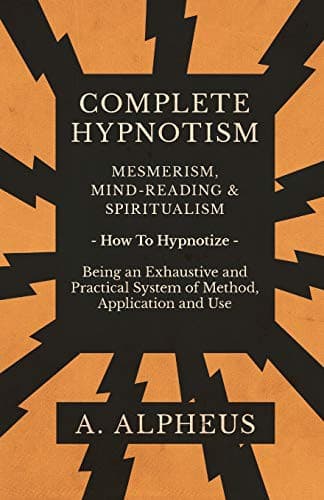
Complete Hypnotism, Mesmerism, Mind-Reading and Spiritualism: How to Hypnotize: Being an Exhaustive and Practical System of Method, Application, and UseAlpheus, A.
History
Complete Hypnotism, Mesmerism, Mind-Reading and Spiritualism: How to Hypnotize: Being an Exhaustive and Practical System of Method, Application, and Use
Alpheus, A.
Hypnotism; Mesmerism; Spiritualism; Telepathy
Soon after this Burdin, a member of the Academy, offered a prize of
3,000 francs to any one who would read the number of a bank-note or the
like with his eyes bandaged (under certain fixed conditions), but it
was never awarded, though many claimed it, and there has been
considerable evidence that persons in the hypnotic state have
(sometimes) remarkable clairvoyant powers.
Soon after this, magnetism fell into very low repute throughout France
and Germany, and scientific men became loath to have their names
connected with the study of it in any way. The study had not yet been
seriously taken up in England, and two physicians who gave some
attention to it suffered decidedly in professional reputation.
It is to an English physician, however, that we owe the scientific
character of modern hypnotism. Indeed he invented the name of
hypnotism, formed from the Greek word meaning ‘sleep’, and designating
‘artificially produced sleep’. His name is James Braid, and so
important were the results of his study that hypnotism has sometimes
been called “Braidism”. Doctor Courmelles gives the following
interesting summary of Braid’s experiences:
“November, 1841, he witnessed a public experiment made by Monsieur
Lafontaine, a Swiss magnetizer. He thought the whole thing a comedy; a
week after, he attended a second exhibition, saw that the patient could
not open his eyes, and concluded that this was ascribable to some
physical cause. The fixity of gaze must, according to him, exhaust the
nerve centers of the eyes and their surroundings. He made a friend look
steadily at the neck of a bottle, and his own wife look at an
ornamentation on the top of a china sugar bowl: sleep was the
consequence. Here hypnotism had its origin, and the fact was
established that sleep could be induced by physical agents. This, it
must be remembered, is the essential difference between these two
classes of phenomena (magnetism and hypnotism): for magnetism supposes
a direct action of the magnetizer on the magnetized subject, an action
which does not exist in hypnotism.”
It may be stated that most English and American operators fail to see
any distinction between magnetism and hypnotism, and suppose that the
effect of passes, etc., as used by Mesmer, is in its way as much
physical as the method of producing hypnotism by concentrating the gaze
of the subject on a bright object, or the like.
Public-domain text, read in full here on John Shaqi.
Reviews
Reviews
No reviews yet
Be the first to share your thoughts on this work.
Join the Discussion
Join the discussion
Sign in to leave a comment or review.
Sign InorCreate an account