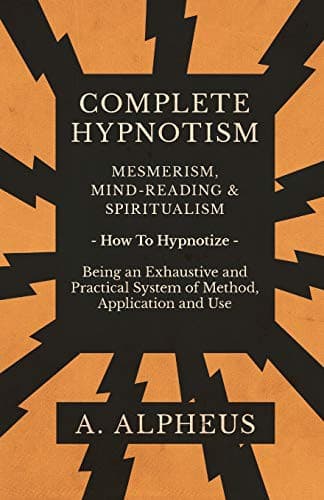
Complete Hypnotism, Mesmerism, Mind-Reading and Spiritualism: How to Hypnotize: Being an Exhaustive and Practical System of Method, Application, and UseAlpheus, A.
History
Complete Hypnotism, Mesmerism, Mind-Reading and Spiritualism: How to Hypnotize: Being an Exhaustive and Practical System of Method, Application, and Use
Alpheus, A.
Hypnotism; Mesmerism; Spiritualism; Telepathy
Time and scientific progress have largely overthrown Mesmer’s theories
of the fluid; yet Mesmer had made a discovery that was in the course of
a hundred years to develop into an important scientific study. Says
Vincent: “It seems ever the habit of the shallow scientist to plume
himself on the more accurate theories which have been provided for him
by the progress of knowledge and of science, and then, having been fed
with a limited historical pabulum, to turn and talk lightly, and with
an air of the most superior condescension, of the weakness and follies
of those but for whose patient labors our modern theories would
probably be non-existent.” If it had not been for Mesmer and his
“Animal Magnetism”, we would never have had “hypnotism” and all our
learned societies for the study of it.
Mesmer, though his pretensions were discredited, was quickly followed
by Puysegur, who drew all the world to Buzancy, near Soissons, France.
“Doctor Cloquet related that he saw there, patients no longer the
victims of hysterical fits, but enjoying a calm, peaceful, restorative
slumber. It may be said that from this moment really efficacious and
useful magnetism became known.” Every one rushed once more to be
magnetized, and Puysegur had so many patients that to care for them all
he was obliged to magnetize a tree (as he said), which was touched by
hundreds who came to be cured, and was long known as “Puysegur’s tree”.
As a result of Puysegur’s success, a number of societies were formed in
France for the study of the new phenomena.
In the meantime, the subject had attracted considerable interest in
Germany, and in 1812 Wolfart was sent to Mesmer at Frauenfeld by the
Prussian government to investigate Mesmerism. He became an enthusiast,
and introduced its practice into the hospital at Berlin.
In 1814 Deleuze published a book on the subject, and Abbe Faria, who
had come from India, demonstrated that there was no fluid, but that the
phenomena were subjective, or within the mind of the patient. He first
introduced what is now called the “method of suggestion” in producing
magnetism or hypnotism. In 1815 Mesmer died.
Experimentation continued, and in the 20’s Foissac persuaded the
Academy of Medicine to appoint a commission to investigate the subject.
After five years they presented a report. This report gave a good
statement of the practical operation of magnetism, mentioning the
phenomena of somnambulism, anesthesia, loss of memory, and the various
other symptoms of the hypnotic state as we know it. It was thought that
magnetism had a right to be considered as a therapeutic agent, and that
it might be used by physicians, though others should not be allowed to
practice it. In 1837 another commission made a decidedly unfavorable
report.
Public-domain text, read in full here on John Shaqi.
Reviews
Reviews
No reviews yet
Be the first to share your thoughts on this work.
Join the Discussion
Join the discussion
Sign in to leave a comment or review.
Sign InorCreate an account