[Footnote: L'Enchanteur pourrissant, par Guillaume Apollinaire,
avec illustrations gravees sur bois par Andre Derain. Paris,
Kahnweiler, 1910.]
Here is work which keeps the merest semblance of conventional
form, which gives its effect by startling masses of black and
white, by sudden curves, but more frequently by sudden angles.
[Footnote: The renaissance of the angle in art is an interesting
feature of the new movement. Not since Egyptian times has it been
used with such noble effect. There is a painting of Gauguin's at
Hagen, of a row of Tahitian women seated on a bench, that
consists entirely of a telling design in Egyptian angles. Cubism
is the result of this discovery of the angle, blended with the
influence of Cezanne.]
In the process of the gradual abandonment of natural form the
"angle" school is paralleled by the "curve" school, which also
descends wholly from Gauguin. The best known representative is
Maurice Denis. But he has become a slave to sentimentality, and
has been left behind. Matisse is the most prominent French artist
who has followed Gauguin with curves. In Germany a group of young
men, who form the Neue Kunstlevereinigung in Munich, work almost
entirely in sweeping curves, and have reduced natural objects
purely to flowing, decorative units.
But while they have followed Gauguin's lead in abandoning
representation both of these two groups of advance are lacking in
spiritual meaning. Their aim becomes more and more decorative,
with an undercurrent of suggestion of simplified form. Anyone who
has studied Gauguin will be aware of the intense spiritual value
of his work. The man is a preacher and a psychologist, universal
by his very unorthodoxy, fundamental because he goes deeper than
civilization. In his disciples this great element is wanting.
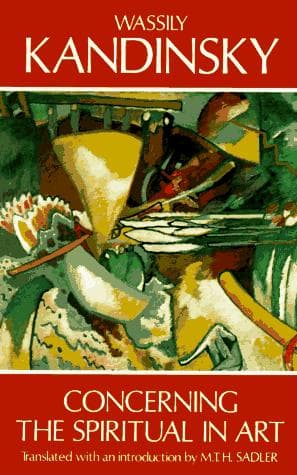
Kandinsky has supplied the need. He is not only on the track of
an art more purely spiritual than was conceived even by Gauguin,
but he has achieved the final abandonment of all representative
intention. In this way he combines in himself the spiritual and
technical tendencies of one great branch of Post-Impressionism.
The question most generally asked about Kandinsky's art is: "What
is he trying to do?" It is to be hoped that this book will do
something towards answering the question. But it will not do
everything. This--partly because it is impossible to put into
words the whole of Kandinsky's ideal, partly because in his
anxiety to state his case, to court criticism, the author has
been tempted to formulate more than is wise. His analysis of
colours and their effects on the spectator is not the real basis
of his art, because, if it were, one could, with the help of a
scientific manual, describe one's emotions before his pictures
with perfect accuracy. And this is impossible.
Public-domain text, read in full here on John Shaqi.
Reviews
Reviews
No reviews yet
Be the first to share your thoughts on this work.
Join the Discussion
Join the discussion
Sign in to leave a comment or review.
Sign InorCreate an account