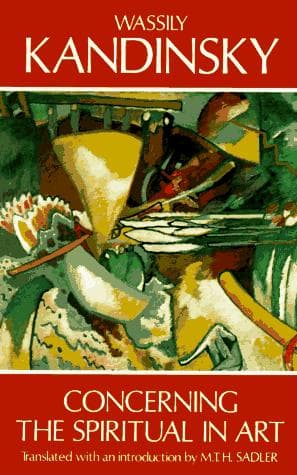
Kandinsky is painting music. That is to say, he has broken down
the barrier between music and painting, and has isolated the pure
emotion which, for want of a better name, we call the artistic
emotion. Anyone who has listened to good music with any enjoyment
will admit to an unmistakable but quite indefinable thrill. He
will not be able, with sincerity, to say that such a passage gave
him such visual impressions, or such a harmony roused in him such
emotions. The effect of music is too subtle for words. And the
same with this painting of Kandinsky's. Speaking for myself, to
stand in front of some of his drawings or pictures gives a keener
and more spiritual pleasure than any other kind of painting. But
I could not express in the least what gives the pleasure.
Presumably the lines and colours have the same effect as harmony
and rhythm in music have on the truly musical. That psychology
comes in no one can deny. Many people--perhaps at present the
very large majority of people--have their colour-music sense
dormant. It has never been exercised. In the same way many people
are unmusical--either wholly, by nature, or partly, for lack of
experience. Even when Kandinsky's idea is universally understood
there may be many who are not moved by his melody. For my part,
something within me answered to Kandinsky's art the first time I
met with it. There was no question of looking for representation;
a harmony had been set up, and that was enough.
Of course colour-music is no new idea. That is to say attempts have been
made to play compositions in colour, by flashes and harmonies.
[Footnote: Cf. "Colour Music," by A. Wallace Rimington. Hutchinson. 6s.
net.] Also music has been interpreted in colour. But I do not know of
any previous attempt to paint, without any reference to music,
compositions which shall have on the spectator an effect wholly divorced
from representative association. Kandinsky refers to attempts to paint
in colour-counterpoint. But that is a different matter, in that it is
the borrowing from one art by another of purely technical methods,
without a previous impulse from spiritual sympathy.
Public-domain text, read in full here on John Shaqi.
Reviews
Reviews
No reviews yet
Be the first to share your thoughts on this work.
Join the Discussion
Join the discussion
Sign in to leave a comment or review.
Sign InorCreate an account