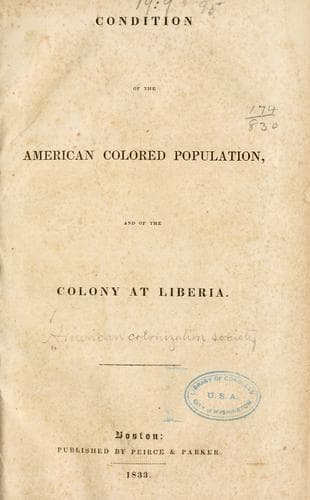
Condition of the American Colored Population, and of the Colony at LiberiaAmerican Colonization Society
History
Condition of the American Colored Population, and of the Colony at Liberia
American Colonization Society
African Americans -- Colonization -- Africa; Enslaved persons -- United States -- Social conditions
Thus, in the case under consideration, it is equally true, that
all attempts to provide for the relief of the free black and slave
population of the country, must prove abortive if unattended by
facts and statements relative to their actual condition. It would
not be difficult to show that the same society, from whose advocates
the complaint in question is heard, in its statements and arguments
touching the situation of the slaves, is as truly _their_ disparager as
is the Colonization Society the “disparager of the free blacks.”
The statements which follow are called for by the necessity of the
case. They are not made in a spirit of taunt, or reproach, or boasted
superiority, but with the hope that they may serve to call forth that
commiseration which the cause of the deeply-injured African, when truly
stated, challenges for itself.
1. _Intellectual Condition of the Free Blacks._ Notwithstanding
the privileges of education are nominally extended to them in the
New-England, Middle, and some of the Southern and Western States, yet
the prejudice which exists against their color serves to defeat, to
a lamentable extent, the benevolent provisions of the law. In some
cities and large towns, schools are maintained expressly for them.
In Philadelphia, particularly, there are many distinct schools for
colored children, some of which have at different times been taught by
colored tutors, and much to their credit. “In these schools,” says a
gentleman of that city, “where they have been under the superintendence
of qualified instructers, forty years’ experience has proved, that they
are no way inferior to the whites in the acquirement of learning.” In
the country towns of the states above referred to, the children of the
blacks are not unfrequently found in common schools with the whites.
But their situation is frequently made so uncomfortable that most of
the benefits of such attendance are lost. Still more unfrequently are
they to be found at Academies or high schools even in New-England--and
still more rarely do they find their way into Colleges. Mr. Russwurm,
now in Liberia, is a graduate of Bowdoin College. Attempts were
made some time since to establish a college exclusively for them
in New-Haven, Conn. The plan, meeting with decided opposition from
the inhabitants of that town, was finally abandoned. An attempt has
been recently made to establish a high school for colored females
in Canterbury, Conn. Vigorous and determined opposition has been
manifested towards it by the inhabitants, so that its success is still
doubtful. In many of the slave states, free blacks are not allowed to
attend school, or to learn to read or write. Many of them, however,
enjoy the benefits of sabbath school instruction, and commit to memory
considerable portions of Scripture, &c. Yet a great majority are no
doubt lamentably and grossly ignorant.
Public-domain text, read in full here on John Shaqi.
Reviews
Reviews
No reviews yet
Be the first to share your thoughts on this work.
Join the Discussion
Join the discussion
Sign in to leave a comment or review.
Sign InorCreate an account