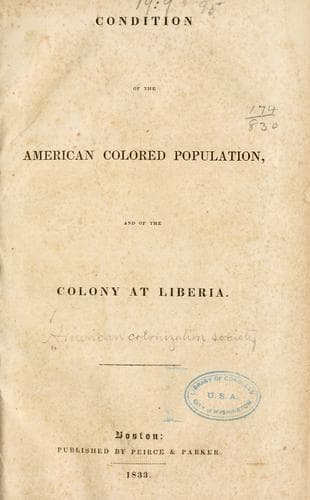
Condition of the American Colored Population, and of the Colony at LiberiaAmerican Colonization Society
History
Condition of the American Colored Population, and of the Colony at Liberia
American Colonization Society
African Americans -- Colonization -- Africa; Enslaved persons -- United States -- Social conditions
8. In New England and the Middle States, (a late law in Connecticut
excepted) there appears to be no distinction made by law, with
reference to the privileges of education or religious worship, between
the blacks and the whites. In all these states, and in Missouri,
Maryland, Delaware and Ohio, they are allowed by law, not only to
send their children to the public schools, but to establish schools
for themselves exclusively. Many such schools are patronized by the
benevolent friends of the race among the whites. By a late law of
Ohio, they cannot receive any benefit from the public school funds.
In Alabama, they may not attend schools or have instruction among
themselves. A prohibitory law, passed in Georgia, about eighteen
months since, debars them from all the privileges of school education
in that state. They may however be taught the catechism, or such moral
lessons and portions of Scripture as they can commit to memory. With
respect to other states no definite information has been received. In
Connecticut a law has recently been passed forbidding the establishment
of schools for the education of colored children from other states.
III. _Intellectual and Moral Condition of the Free Blacks._
It is to be feared that the statements now to be made will meet with
an ungracious reception among a certain portion of the community.
As a powerful means of enlisting public sympathy in behalf of the
African race, the advocates of the Society have sometimes entered into
an exposition of such facts as would most accurately unfold their
intellectual and moral condition. Accordingly, those who oppose the
Society have attempted to show that it is the “disparager of the free
blacks.”
It were, however, wholly impracticable to arouse public sympathy,
either where no suffering or degradation exists, or where their
existence is unknown. All benevolent operations must proceed upon the
supposition that there is want to be alleviated, or ignorance to be
enlightened, or degradation to be pitied; and the vigor with which such
operations are sustained by the benevolent will be proportioned, not
so much to the degree of this want, ignorance and degradation, as to
their thorough and perfect exposure. The Colonization Society is not
singular in its proceedings. In whatsoever sense this society is the
“disparager of the free blacks,” in the same sense are the Bible and
Tract Societies the “disparagers” of those to whom they extend their
benevolence. In the same sense also, and to a higher degree, is the
Foreign Missionary Board the “disparager” of the Heathen. Were that
society to deny or to conceal the deep degradation and licentiousness
of the American Indians, and of the Pagan world generally, it is
difficult to conceive with what arguments they could successfully
approach the sympathies of their patrons.
Public-domain text, read in full here on John Shaqi.
Reviews
Reviews
No reviews yet
Be the first to share your thoughts on this work.
Join the Discussion
Join the discussion
Sign in to leave a comment or review.
Sign InorCreate an account