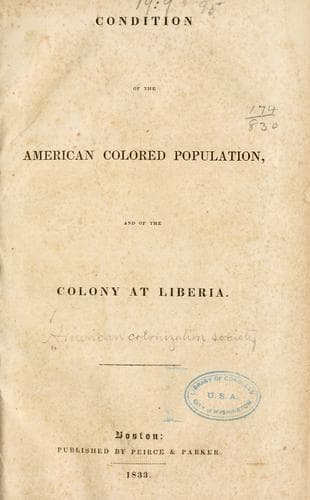
Condition of the American Colored Population, and of the Colony at LiberiaAmerican Colonization Society
History
Condition of the American Colored Population, and of the Colony at Liberia
American Colonization Society
African Americans -- Colonization -- Africa; Enslaved persons -- United States -- Social conditions
But again, the objection supposes that for us to respect our fellow,
and do unto him as we would have him do unto us, we should consider his
circumstances in every respect the same as our own. It supposes that
our duty to the blacks requires us, in order to do him the greatest
possible good, to treat him in all particulars, as we ourselves need
to be treated--that we are not to consider age, character, color,
constitution, nor any other circumstance or condition of life as making
any difference, but that we must regard him, without qualification,
just as _we_ are. Now this could not be true of any two white men in
the country, much less of the whites and blacks, whose condition, in
every respect differs most widely. Nor do the Sacred Scriptures require
this. They suppose that we are to regard the difference of condition
between ourselves and others. We are to do to others as we would
that they should do to us in like circumstances, it being remembered
that the circumstances of no two persons in the world are alike. If,
therefore, we treat the negro in a manner which we suppose will promote
his highest temporal and eternal good, we are not to be charged with
acting under the influence of prejudice, because we do not treat a
white man in the same manner. The circumstances of the two are so wide
apart, that what would be a blessing to the one, would be ruinous to
the other. We think it would be better to carry the negro to Africa
and colonize him _there_, (with his own free will, of course) under a
climate suited to his constitution, and under laws and institutions
calculated to make him wise and happy, than to keep him here under the
withering influences which are operating against him. Are we therefore
under the influence of prejudice? If we are, it is a prejudice which
duty prompts us exercise. But we have bestowed more attention to
this objection than it deserves. Nothing can be plainer than that
the colonization scheme has had a great influence in weakening this
prejudice against the blacks, and creating an interest in their behalf,
which must, in the nature of things, continue to increase until the
whole race shall be restored to an equality with the whites.
3. Colonization exerts a favorable influence on the interests of the
blacks, by improving their character and elevating their condition, so
as to remove objections from the minds of those who oppose them.
Public-domain text, read in full here on John Shaqi.
Reviews
Reviews
No reviews yet
Be the first to share your thoughts on this work.
Join the Discussion
Join the discussion
Sign in to leave a comment or review.
Sign InorCreate an account