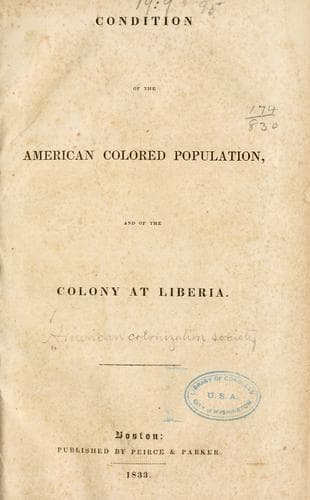
Condition of the American Colored Population, and of the Colony at Liberia — John Shaqi
Condition of the American Colored Population, and of the Colony at LiberiaAmerican Colonization Society
History
Condition of the American Colored Population, and of the Colony at Liberia
American Colonization Society
African Americans -- Colonization -- Africa; Enslaved persons -- United States -- Social conditions
Before the Society commenced operations the character of the negro was
degraded to a level with the brutes. They were even called brutes,
and books were written to show that they were not human. But since
the days of colonization such thoughts and feelings have been laid
aside. Men have begun to recognize the negro as a man, and treat him
as such; and he himself has become conscious of his power. Says a
writer in the Christian Spectator, “Not Hayti has done more to make
the negro character respected by mankind and to afford the means of
making the _negro_ conscious of his manhood, than Liberia has already
accomplished. The name of Lott Carey is worth more than the name of
Boyer or Petion. It has done, it is doing more to rescue the African
character from degradation, than could be done by a thousand volumes
against prejudice.” And thus the writer goes on to say, “it has done,
and is doing more to accelerate the abolition of slavery than could
be done by a ship-load of such pamphlets and speeches as some that we
might mention. Elevate the character of the free people of color--let
it be seen that they are men indeed--let the degrading associations
that follow them be broken up by the actual improvement of their
character, as a people, and negro slavery must rapidly wither and die.
4. Colonization exerts a favorable influence on the general interest
of the blacks, especially by directing the thoughts of slave-holders
to the subject of emancipation, as well as actually securing, in many
cases, the emancipation of slaves. Of this we have abundant evidence.
Almost every week we hear of some slave, or a number of slaves, who
have been emancipated. We hear also of many persons who are willing
to give freedom to their slaves, providing they can be removed from
the soil. There are multitudes of this description in Kentucky; and
in Missouri a large proportion of the slave-holders are willing and
desirous of doing this. A letter from a gentleman in St. Louis,
says, “A great change has taken place here within ten years on the
subject of slavery. The advocates of perpetual bondage are very few.
The slaves are, in many instances, an expense to their owners; and
the Colonization Society is looked to as the only hope of ridding the
land of the burden.” The same may be said of numbers in the other
slave-holding states. On this subject, the writer above alluded to
remarks, “This is not conjecture. The friends of colonization in their
arguments can read off a catalogue of instances in which emancipation
has already resulted from the progress of this work. We know that
on the other hand it is said that the arguments and statements of
colonizationists prevent emancipation. But the proper proof of this
assertion would be to bring forward the particular facts. Tell us
of the individuals who have in fact been effectually hindered from
setting their slaves at large by what they have read in the African
Public-domain text, read in full here on John Shaqi.
Reviews
Reviews
No reviews yet
Be the first to share your thoughts on this work.
Join the Discussion
Join the discussion
Sign in to leave a comment or review.
Sign InorCreate an account