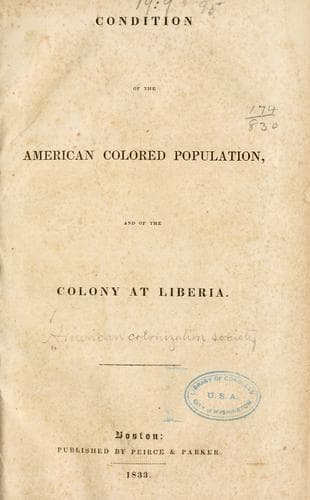
Condition of the American Colored Population, and of the Colony at LiberiaAmerican Colonization Society
History
Condition of the American Colored Population, and of the Colony at Liberia
American Colonization Society
African Americans -- Colonization -- Africa; Enslaved persons -- United States -- Social conditions
The above table was compiled from Niles’ Register for January 26th,
1822, page 345, and for October 29th, 1831, page 176. The blanks in the
fourth column show that instead of an increase, there was an actual
diminution of slaves during the ten years comprised in the table. The
diminution in Maryland was 4,520, and in the District of Columbia 313.
In some others they have nearly disappeared. It appears however from
the table, that in the Southern States, particularly those south of
Virginia, there has been an astonishing increase of slaves. In some of
the States it has surpassed the increase of the whites by forty, fifty,
and even an hundred and fifty per cent. In Arkansas the increase of the
slave population has surpassed the white by 166 per cent.
The following table shows the relative strength of the white and black
population in the slave holding states, at the close of each successive
10 years, to the end of the present century, supposing the rate of
increase to continue as it has been during the last ten. The table is
taken from calculations made during the year by the Hon. Daniel Mayes,
of Kentucky.
1840, Whites, 4,523,248 Blacks, 3,041,456
1850, “ 5,789,737 “ 4,136,380
1860, “ 7,131,863 “ 6,625,476
1870, “ 9,129,770 “ 9,010,647
1880, “ 11,696,110 “ 12,434,451
1890, “ 14,967,420 “ 16,910,853
1900, “ 18,158,297 “ 22,898,700
From the above table it appears that in 1900, should nothing take place
to diminish the increase of blacks in the slave-holding states, they
will exceed the whites by 4,741,166--being an amount greater than the
population of all the United States under Washington’s administration.
II. _Civil Disabilities of the Slaves._
The following statements have been taken principally from STROUD’S
SKETCH of the Laws relative to slavery in the United States. They
may be regarded as corollaries from the _general law_ concerning the
slaves, and also as matters of express legislation.
1. Slaves have no legal rights of property in things real or personal;
but whatever they may acquire, belongs in _point of law_ to their
masters. (The bearing of this on the purchase of freedom is obvious.)
2. The slave, being a _personal chattel_, is at all times liable to be
sold absolutely, or mortgaged or leased at the will of his master.
3. He may also be sold by process of law, for the satisfaction of the
debts of a living, or the bequests of a deceased master, at the suit of
creditors or legatees.
4. A slave cannot be a party, before a judicial tribunal, in any
species of action, against his master, whatever may have been the
injury received from him.
5. Slaves cannot redeem themselves, nor obtain a change of masters.
6. Slaves being objects of _property_ if injured by third persons,
their owners may bring suit, and recover damages, for the injury.
7. Slaves can make no contract.
8. Slavery is hereditary and perpetual.
Public-domain text, read in full here on John Shaqi.
Reviews
Reviews
No reviews yet
Be the first to share your thoughts on this work.
Join the Discussion
Join the discussion
Sign in to leave a comment or review.
Sign InorCreate an account