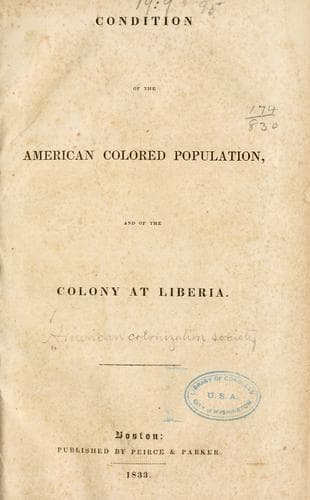
Condition of the American Colored Population, and of the Colony at LiberiaAmerican Colonization Society
History
Condition of the American Colored Population, and of the Colony at Liberia
American Colonization Society
African Americans -- Colonization -- Africa; Enslaved persons -- United States -- Social conditions
It may also be further stated concerning the disabilities of the slave,
1. That he cannot be a witness against a white person, either in a
civil or criminal cause.
2. He cannot be a party to a civil suit.
3. Submission is required of the slave, not to the will of his master
only, but to that of all other white persons.
4. The penal codes of the slave holding states bear much more severely
upon the slaves than upon the white persons,--taking the life of the
slave, where a slight punishment only is inflicted upon the whites.
5. Slaves are prosecuted and tried upon criminal accusations, in many
of the states, without a jury.
The condition of the slave, as regards emancipation, is peculiarly
distressing.
The state of society in the slave holding states, and legislative
enactments, have rendered it nearly impossible for any master to
emancipate his slave.
In Virginia and Mississippi, an emancipated slave may be taken in
execution to satisfy any debt, contracted by the person emancipating
him, previous to such emancipation.
In Kentucky, the Act which authorises emancipation, contains a
reservation of the rights of creditors.
In Louisiana, any enfranchisement made in _fraud of creditors_, &c. is
null and void.
In South Carolina, Georgia, Alabama and Mississippi, it is only
by authority of the Legislature, specially granted, that a valid
emancipation can be made.
In North Carolina it was enacted in 1777, that no negro or mulatto
slave shall be hereafter set free, except for _meritorious service to
be adjudged of and allowed by the County Court_, and license first had
and obtained thereupon.
The laws of Kentucky, Missouri, Virginia and Maryland, afford greater
facility to emancipation than the other slave holding states. In
Virginia, however, there is a provision by which every emancipated
negro, over twenty one years of age, who shall continue within the
state more than twelve months after his right to freedom shall have
accrued, may be again reduced to slavery.
In order to secure the slave holding states in the use and possession
of their property in the persons of slaves, and to prevent all escape
of slaves from their masters, the constitution of the United States
provides, “That no person held to service or labor in one state, under
the laws thereof, _escaping_ into another, shall, in consequence of any
law or regulation therein, be discharged from such service or labor,
but shall be delivered up, on claim of the party to whom such service
or labor may be due.”
III. _Intellectual and Moral Condition of the Slaves._
The benefits of education are withheld from the slave.
No provisions are made in any of the slave states for the education of
the slaves, and in many they have absolutely prohibited instruction of
any kind.
Public-domain text, read in full here on John Shaqi.
Reviews
Reviews
No reviews yet
Be the first to share your thoughts on this work.
Join the Discussion
Join the discussion
Sign in to leave a comment or review.
Sign InorCreate an account