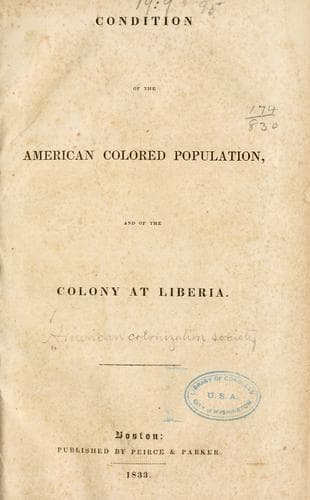
Condition of the American Colored Population, and of the Colony at LiberiaAmerican Colonization Society
History
Condition of the American Colored Population, and of the Colony at Liberia
American Colonization Society
African Americans -- Colonization -- Africa; Enslaved persons -- United States -- Social conditions
So long ago as 1740, South Carolina enacted, “That all, and every
person and persons whatever, who shall hereafter teach, or cause any
slave or slaves to be taught, to write, or shall use or employ any
slave as a scribe in any manner of writing whatsoever hereafter taught,
to write, every such person or persons, shall, for every such offence
forfeit the sum of one hundred pounds current money.” This prohibition
has since been extended to all kinds of knowledge, and enforced by
pains and penalties much more severe. The same is true in Georgia,
Alabama and Louisiana. Virginia and North Carolina, also, have laws
which amount to a prohibition of instruction.
No provision is made for the moral and religious instruction of the
slave. Public sentiment is generally unfavorable, although believed
to be becoming more favorable to the spiritual interests of the
slave. Many regard the slaves as incapable of religious exercises,
and therefore consider all efforts to give them religious instruction
unnecessary. Since they may not be taught to read, they cannot become
acquainted with the Scriptures, except as auditors; their opportunities
for hearing are so few and unfavorable, that they can never be expected
to profit by them. In many of the slave states, they are forbidden
to assemble by themselves for the purpose of religious worship. In
Virginia, “All meetings of slaves, &c. at any _meeting house_ in the
night, under any pretext whatsoever, are declared to be unlawful
assemblies. Mississippi has adopted the law of Virginia in this
respect. In Alabama they are not permitted to assemble by themselves
for worship at all, nor to have a white minister preach to them unless
three slave holders are present. Similar laws exist in several other
states.
CONDITION OF THE FREE BLACKS.
The following statements have respect to the present condition of the
free blacks in the United States. They are all derived from authentic
sources, and may be relied upon as substantially correct.
I. _Population and Increase of the Free Blacks._
In the following tabular view, which is taken from the census of 1830,
and that of 1820, the first column gives the name of the State; the
second, the aggregate of the free colored population; and the third,
the increase of the same, during the ten years which intervened between
1820 and 1830.
Public-domain text, read in full here on John Shaqi.
Reviews
Reviews
No reviews yet
Be the first to share your thoughts on this work.
Join the Discussion
Join the discussion
Sign in to leave a comment or review.
Sign InorCreate an account