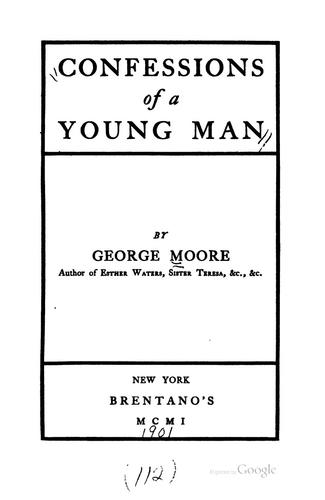
Moore, George, 1852-1933; Paris (France) -- Intellectual life
"Les Palais Nomades" is a really beautiful book, and it is free from all
the faults that make an absolute and supreme enjoyment of great poetry an
impossibility. For it is in the first place free from those pests and
parasites of artistic work--ideas. Of all literary qualities the creation
of ideas is the most fugitive. Think of the fate of an author who puts
forward a new idea to-morrow in a book, in a play, in a poem. The new idea
is seized upon, it becomes common property, it is dragged through newspaper
articles, magazine articles, through books, it is repeated in clubs,
drawing-rooms; it is bandied about the corners of streets; in a week it is
wearisome, in a month it is an abomination. Who has not felt a sickening
feeling come over him when he hears such phrases as "To be or not to be,
that is the question"? Shakespeare was really great when he wrote "Music to
hear, why hearest thou music sadly?" not when he wrote, "The apparel oft
proclaims the man." Could he be freed from his ideas what a poet we should
have! Therefore, let those who have taken firsts at Oxford devote their
intolerable leisure to preparing an edition from which everything
resembling an idea shall be firmly excluded. We might then shut up our
Marlowes and our Beaumonts and resume our reading of the bard, and these
witless beings would confer happiness on many, and crown themselves with
truly immortal bays. See the fellows! their fingers catch at scanty wisps
of hair, the lamps are burning, the long pens are poised, and idea after
idea is hurled out of existence.
Gustave Kahn took counsel of the past, and he has successfully avoided
everything that even a hostile critic might be tempted to term an idea; for
this I am grateful to him. Nor is his volume a collection of miscellaneous
verses bound together. He has chosen a certain sequence of emotions; the
circumstances out of which these emotions have sprung are given in a short
prose note. "Les Palais Nomades" is therefore a novel in essence;
description and analysis are eliminated, and only the moments when life
grows lyrical with suffering are recorded; recorded in many varying metres
conforming only to the play of the emotion, for, unlike many who, having
once discovered a tune, apply it promiscuously to every subject they treat,
Kahn adapts his melody to the emotion he is giving expression to, with the
same propriety and grace as Nature distributes perfume to her flowers. For
an example of magical transition of tone I turn to _Intermède_.
"Chère apparence viens aux couchants illuminés
Veux-tu mieux des matins albes et calmes
Les soirs et les matins ont des calmes rosâtres
Les eaux ont des manteaux de cristal irisé
Et des rythmes de calmes palmes
Et l'air évoque de calmes musique de pâtres.
* * * * *
Public-domain text, read in full here on John Shaqi.
Reviews
Reviews
No reviews yet
Be the first to share your thoughts on this work.
Elsewhere in the archive
Join the Discussion
Join the discussion
Sign in to leave a comment or review.
Sign InorCreate an account