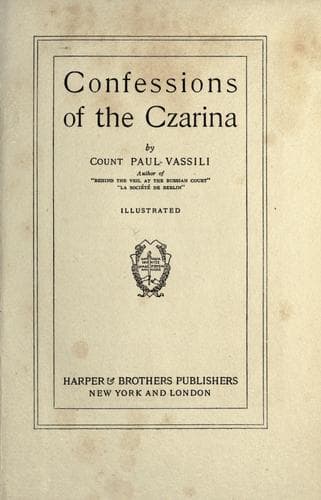
Confessions of the CzarinaRadziwill, Catherine, Princess
History
Confessions of the Czarina
Radziwill, Catherine, Princess
Alexandra, Empress, consort of Nicholas II, Emperor of Russia, 1872-1918; Russia -- Court and courtiers
The engagement was announced on the 20th of April, 1894, but was not
made in Russia the subject of welcome it had been expected. Everybody
felt that love had played no part in this union, which politics alone
had inspired. The open repugnance which the bride displayed for
everything that was Russian, and the hesitation she had shown before
consenting to adopt the orthodox faith, had not predisposed in her
favor St. Petersburg society. The Empress Marie, whose consent had been
a matter of necessity, did not hide the want of sympathy with which this
marriage inspired her; the Imperial Family did not care to see put over
its head the insignificant Princess it had snubbed two years before; the
nation, violently anti-German as it had become, wondered why it had not
been possible to find for its future Sovereign a wife in some other
country than the one which seemed to consider as its right the privilege
of furnishing Russia with its Empresses.
By a curious anomaly, in Darmstadt, and in Berlin, the betrothal was
exceedingly unpopular, and the press spoke of it as of an open scandal,
on account of the change of religion imposed upon the Princess Alix. The
only two people who rejoiced at her good luck were Queen Victoria, who
always liked to see her daughters and granddaughters well married; and
the Kaiser, who, since his earliest years, had been the particular
friend of the future Czarina, and who had succeeded, at the time when
she had shown herself reticent in regard to all her other relatives, in
winning her confidence and her affection, perhaps out of gratitude,
because he had been the only one who had troubled about her in general.
The first weeks which followed upon the engagement of the Cesarewitsch
were spent by him in England, whither his fiancée had repaired, and
while there he had been very much impressed with the grandeur of Great
Britain, and with the kindness which Queen Victoria showed him. He would
have liked nothing better than to be allowed to remain where he was for
an indefinite time, forgetting all about Russia, which (this is
unfortunately an uncontested fact) he never liked nor troubled about.
Events, however, were progressing, and very soon it became evident even
to the most indifferent onlooker that the days of Alexander III. were
numbered. The dying Sovereign was taken to Livadia in the Crimea,
whither his son was hastily recalled. When the latter arrived there took
place a small incident which, better, perhaps, than anything else, will
give an idea of the young man’s utter want of comprehension of the
gravity of the events which went on around him. A few hours after he had
reached Livadia his father’s friend, General Tcherewine, called upon
him, to make him a report concerning the health of the Czar. The Grand
Duke listened to him in silence, then suddenly inquired:
“What have you been doing the whole time you have been here? Have you
been at the theater, and are there any pretty actresses this year?”
Public-domain text, read in full here on John Shaqi.
Reviews
Reviews
No reviews yet
Be the first to share your thoughts on this work.
Join the Discussion
Join the discussion
Sign in to leave a comment or review.
Sign InorCreate an account