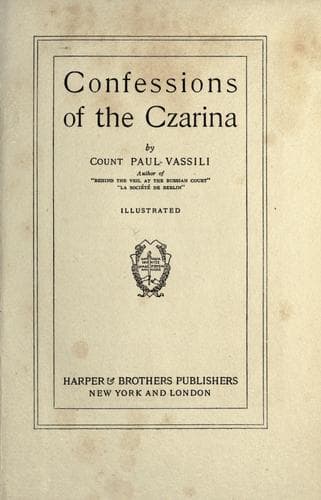
Confessions of the CzarinaRadziwill, Catherine, Princess
History
Confessions of the Czarina
Radziwill, Catherine, Princess
Alexandra, Empress, consort of Nicholas II, Emperor of Russia, 1872-1918; Russia -- Court and courtiers
The General, surprised, replied:
“But, Sir, I could not possibly go to the theater while the Emperor is
so ill.”
“Well, what has this got to do with going or not to the theater; one
must spend one’s evenings somewhere.”
Tcherewine, who related to me himself this story a few weeks later,
added:
“He will always remain the same; he will never understand anything that
goes on around him.”
It was during the last days of the useful life of Alexander III. that
the plan of marrying immediately his son and future successor to the
Princess Alix of Hesse, and of performing the ceremony at Livadia, was
suggested, at the instigation, it is said, of the German Ambassador in
St. Petersburg, General von Schweinitz, who had received instructions
from Berlin to try and hasten the event as much as possible. But the
Czar would not hear of it, declaring that the Heir to the Russian Throne
could not be married privately. He consented, however, to a telegram
being sent to the Princess Alix, inviting her to come at once to
Livadia, to be presented to him. She obeyed the summons, but not without
reluctance. She did not care for her future husband, and as she
elegantly expressed it, to a lady whom she honored with her confidence,
she “did not care to find herself in the Crimea at a time when no one
would think of her, and when she would be compelled to be the fifth
wheel to a coach.” She was, however, persuaded, and left for Warsaw,
where her sister, the Grand-Duchess Elisabeth, was to receive her, and
to accompany her farther.
At Berlin she was met by William II., who traveled with her a part of
the way, and during a long interview which lasted over five hours gave
her his instructions as to what she ought to do in the future. As we
shall see, she was to follow them but too well.
The Princess reached Livadia three days before the Czar breathed his
last. He found sufficient strength to receive her, bless her, and wish
her happiness in her new life. She replied (this must be conceded to
her) with great tact to those solemn words of farewell, and, suddenly
surmounting her previous repugnance, she declared herself ready to
abjure at once the Protestant faith, and to embrace that of her future
husband and subjects. Some people say that she declared she wished to
procure this last joy for Alexander III., but this is doubtful,
considering the fact that her conversion took place only on the morrow
of the death of the latter.
Public-domain text, read in full here on John Shaqi.
Reviews
Reviews
No reviews yet
Be the first to share your thoughts on this work.
Join the Discussion
Join the discussion
Sign in to leave a comment or review.
Sign InorCreate an account