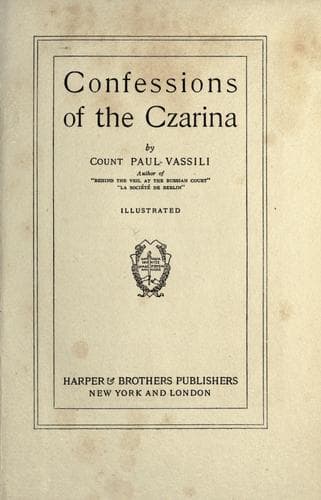
Confessions of the CzarinaRadziwill, Catherine, Princess
History
Confessions of the Czarina
Radziwill, Catherine, Princess
Alexandra, Empress, consort of Nicholas II, Emperor of Russia, 1872-1918; Russia -- Court and courtiers
Many versions exist as to the conduct of Nicholas II. on that awful day.
Some people have said that it was the Empress who had entreated him to
fly to Tsarskoye Selo, where she thought that they would be in greater
safety than in St. Petersburg; others have asserted that it was he who
of his own accord had decided that it would be better for him to leave
the capital and to abandon to his uncle, the Grand-Duke Wladimir, the
task of drowning in blood this attempt of his subjects to enter into
direct communication with him. Probably both versions are right, in a
sense, at least, because it is certain that Alexandra Feodorowna was
always in fear something might happen to her son, and very likely she
tried to induce her husband to consider how best to insure the safety of
their only boy; on the other hand, the Emperor might, had he only come
himself to take a sane view of the situation such as it presented itself
at the time, have been able to reassure his wife and to explain to her
that neither she nor their children were in any danger. Nicholas II.,
however, had only one thought in his small mind, and that was how to
punish this “insolence,” as he termed it, of his people. For him a mob
was always a mob, except when it was ordered to cheer him, and lately he
had had to acknowledge that, in regard to St. Petersburg, cheering had
become rather a rare event.
I am not trying to relate here any of the numerous episodes which have
made the unsuccessful Revolution of 1905 memorable. I am not writing the
history of Nicholas II. Others have done so, and will do so, better than
I could. What I only want to point out is the utter callousness shown by
both the Czar and the Czarina in presence of the abominable repression
which the police, together with some military commanders, inaugurated in
regard to the people compromised even in a slight degree in the movement
of emancipation which had shaken the existence of the dynasty. It was in
vain that some wise people, like Count Witte, for instance, had tried to
explain to Nicholas II. that unless he frankly granted some reforms
without which it would be impossible to govern Russia in the future he
might expect an explosion of wrath on the part of the nation which it
would be almost impossible to subdue or to destroy. The Czar refused to
listen, and when at last he yielded to the demands of his Ministry and
signed the famous Manifest of the 17th of October, with its “simulacre”
of constitution, it was with the firm intention not to keep any of the
promises which it contained, and to try, on the contrary, to reduce to
absolute powerlessness the National Assembly, or Duma, as it was called,
the election of which he had allowed only because he could not help it,
but not at all because he believed or hoped it might prove useful to him
in the solution of the many problems which were waiting to be unraveled.
Public-domain text, read in full here on John Shaqi.
Reviews
Reviews
No reviews yet
Be the first to share your thoughts on this work.
Elsewhere in the archive
Join the Discussion
Join the discussion
Sign in to leave a comment or review.
Sign InorCreate an account