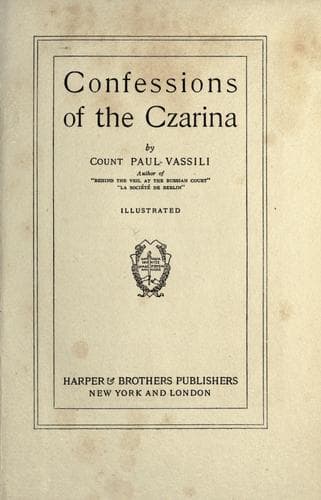
Confessions of the CzarinaRadziwill, Catherine, Princess
History
Confessions of the Czarina
Radziwill, Catherine, Princess
Alexandra, Empress, consort of Nicholas II, Emperor of Russia, 1872-1918; Russia -- Court and courtiers
What followed upon the first convocation of the first Parliament Russia
was to know is already a matter of history. It did not live for more
than a few weeks, and very probably the Czar had never intended it to
exist for any length of time. What he wished was to appear before the
eyes of Europe as a Sovereign who had been willing to make any amount of
sacrifices in order to insure the welfare of his subjects, who, instead
of showing themselves grateful to him for his good intentions, had
rewarded him with the basest ingratitude. He thought this a clever
piece of policy, forgetting that any politician worthy of the name could
see at once through his game, and that this game could have only one
result--that of inspiring an utter contempt for his person as well as
for his moral character.
Therein lies the great, the supreme, fault of Nicholas II. He never
could bring himself to act frankly in regard to any serious matter in
which his people were concerned. The Empress, in her strange way, was
far more honest, because she did not hesitate to follow the instincts of
her heart, and in her most mistaken actions she was at least sincere.
During the years that followed upon the insurrectionary movement of 1905
Alexandra Feodorowna was in such a state of health that it was almost
impossible for her to take any part in what went on around her. Her
reason had been seriously compromised by the shock caused by the
tragical ending of the only romance she had known in her life, and she
used to spend hours weeping in her room, absorbed in the contemplation
of her own grief. It was in vain that Anna Wyrubewa, who had become more
intimate with her than had even been the case before, had tried to
induce her to fight the morbid ideas which were torturing her. The
Empress would not listen to her friend, and insisted on secluding
herself from the world and even from her own daughters, whose presence
irritated her and made her give way to fits of impatience that were very
nearly akin to madness. The girls were perfectly charming and had the
luck to have an excellent governess, who tried to give them the love
their own mother refused or was unable to award them; nevertheless their
lives were blighted by the illness of the Empress, and it is not
extraordinary that they came to care for their father more than for her,
whom they were always more or less afraid to approach, whom they were
constantly told they must not bother by questions of any kind or
manifestations of affection.
Public-domain text, read in full here on John Shaqi.
Reviews
Reviews
No reviews yet
Be the first to share your thoughts on this work.
Elsewhere in the archive
Join the Discussion
Join the discussion
Sign in to leave a comment or review.
Sign InorCreate an account