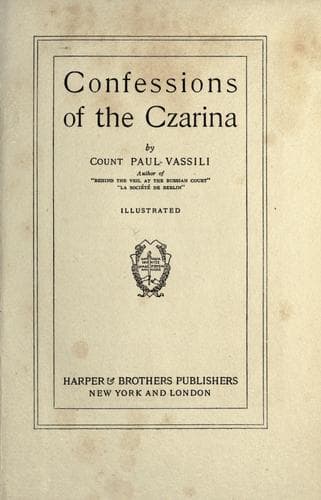
Confessions of the CzarinaRadziwill, Catherine, Princess
History
Confessions of the Czarina
Radziwill, Catherine, Princess
Alexandra, Empress, consort of Nicholas II, Emperor of Russia, 1872-1918; Russia -- Court and courtiers
Such, for instance, was the house of the Countess Sophy Ignatieff, where
the higher clergy used to meet at weekly assemblies, during which the
laxity of the younger generation in regard to religious matters was
discussed with many a sigh and many a shaking of wise heads, disposed to
admit that this religious indifference, which was getting stronger and
stronger every day, was bound to bring Russia to the brink of terrible
misfortunes. Countess Ignatieff had traveled all over her native country
in search of its sacred shrines and places, and was very well known
personally in almost all the principal convents in the Empire. She had
been suspected at one time of sympathies with dissenters, but this has
never been proved; on the contrary, in her old age she gained the
reputation of being fanatically orthodox, one who saw no salvation
outside the fold of her own creed, who favored persecution of all others
on account of her conviction that people ought to be brought back to the
bosom of the Greek Church by any means, even through violence if other
ones failed.
During one of the yearly pilgrimages in which so much of her time was
spent she had had occasion to meet a kind of vagrant preacher whose wild
eloquence had captivated her fancy and her imagination, and she had been
partly instrumental in his coming to St. Petersburg, where she had
arranged for him to hold religious meetings in her house, to which she
had invited prominent church dignitaries, together with a few ladies of
an enthusiastic turn of mind whom she believed would be inclined to
listen to the wild ravings, for they were nothing else, of her new
_protégé_.
At first people laughed at her, as well as at the uncouth appearance of
the “Prophet of God,” as she called him, who, while not blessed with the
eloquence of a Savonarola, yet possessed sufficient persuasive gifts and
talents to shake the equanimity of the hysterically inclined women who
listened to him. This “Prophet” was none other than Grigory Raspoutine,
who later on was to become such an important personage in Russia.
Public-domain text, read in full here on John Shaqi.
Reviews
Reviews
No reviews yet
Be the first to share your thoughts on this work.
Elsewhere in the archive
Join the Discussion
Join the discussion
Sign in to leave a comment or review.
Sign InorCreate an account