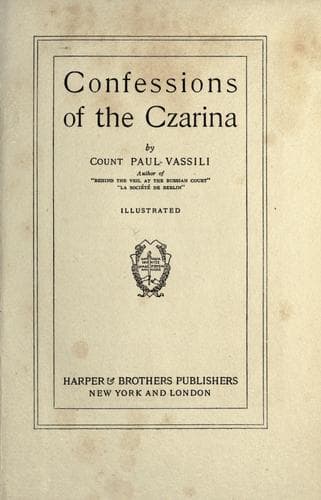
Confessions of the CzarinaRadziwill, Catherine, Princess
History
Confessions of the Czarina
Radziwill, Catherine, Princess
Alexandra, Empress, consort of Nicholas II, Emperor of Russia, 1872-1918; Russia -- Court and courtiers
Madame Wyrubewa had heard about Raspoutine a long time before she ever
came to hear him. But after she had had the opportunity of meeting him
she thought that it would not be a bad thing to bring him to Tsarskoye
Selo, where the poor Empress was eating away her heart in her grief at
the loss of all that she had cared for in life, and to try to induce
Alexandra to listen to him, and to pray together with him. He was
supposed to perform wonders by the intensity and the fervor of his
prayers, and it might just be possible that the very fact of his being a
complete stranger to her, and moreover a man totally outside Court
circles and Court intrigues, would influence the Czarina to give him her
confidence and to permit him to cheer her up. At all events, she spoke
about him several times, and pleaded hard with the Empress to allow him
to be brought to her. This Alexandra Feodorowna absolutely refused, but
she was induced at last to consent to see him at the house of Anna
Wyrubewa, and thither came one winter evening the adventurer who was in
time to become the Cagliostro of a reign which was not even worthy to
have any one else but a common, uncouth peasant for its jester.
Now, as has been ultimately proved, Raspoutine was far from being the
saintly man his admirers thought he was, but he was endowed with an
unusual amount of cunning, and far more spirit of observation than he
was credited with. When he was told that he would have the honor of
meeting the Empress of Russia, and to pray in her presence for the
health of her delicate little boy, he had at once perceived the
advantages which might result for him out of this introduction, if only
in regard to his personal prestige before his disciples and followers.
He was above everything else a man who cared for his enjoyment as well
as for the good things of life, and who, in the way of Paradise, only
admitted the one described by Mohammed in his Koran. He had led a
licentious, godless kind of existence, which he had contrived to
persuade the weak women who had succumbed to his exhortations was in
accord with the spirit of the doctrine which he preached, the principal
points of which consisted in blind submission to his will and to his
fancies. He had told them that they would be cleansed of their sins by a
complete union with him, which he meant in the physical as well as in
the moral sense of the word. It is probable that in his dealings with
all the people who had grown to believe in him he had had recourse to
his incontestable hypnotical powers and to practices of magnetic
influence which he had learned amid some wild tribes of Siberia, where
he had spent his childhood and early youth, who are to this day adepts
in the art of witchcraft as well as in all kinds of magical rites and
customs. At the same time the crafty adventurer knew very well that it
would be unwise of him at the beginning of his intercourse with the
Consort of his Sovereign, an intercourse which he was fully determined
Public-domain text, read in full here on John Shaqi.
Reviews
Reviews
No reviews yet
Be the first to share your thoughts on this work.
Elsewhere in the archive
Join the Discussion
Join the discussion
Sign in to leave a comment or review.
Sign InorCreate an account