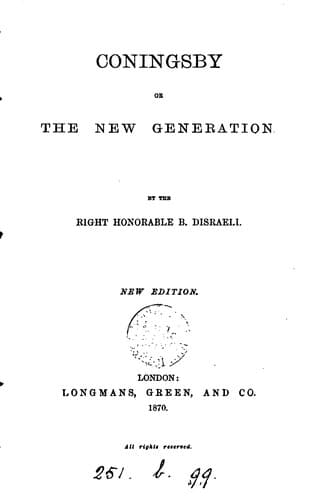
Coningsby; Or, The New GenerationDisraeli, Benjamin, Earl of Beaconsfield
General
Coningsby; Or, The New Generation
Disraeli, Benjamin, Earl of Beaconsfield
Great Britain -- Fiction; Political fiction; Politicians -- Fiction
Of late, however, a considerable change had taken place in the Duke’s
feelings on this great question. His son Henry entertained strong
opinions upon it, and had combated his father with all the fervour of a
young votary. A victory over his Grace, indeed, was not very difficult.
His natural impulse would have enlisted him on the side, if not of
opposition to the new system, at least of critical suspicion of its
spirit and provisions. It was only the statistics and sharp acuteness
of his son-in-law that had, indeed, ever kept him to his colours. Lord
Henry would not listen to statistics, dietary tables, Commissioners’
rides, Sub-commissioners’ reports. He went far higher than his father;
far deeper than his brother-in-law. He represented to the Duke that the
order of the peasantry was as ancient, legal, and recognised an order as
the order of the nobility; that it had distinct rights and privileges,
though for centuries they had been invaded and violated, and permitted
to fall into desuetude. He impressed upon the Duke that the parochial
constitution of this country was more important than its political
constitution; that it was more ancient, more universal in its influence;
and that this parochial constitution had already been shaken to its
centre by the New Poor Law. He assured his father that it would never be
well for England until this order of the peasantry was restored to its
pristine condition; not merely in physical comfort, for that must vary
according to the economical circumstances of the time, like that of
every class; but to its condition in all those moral attributes which
make a recognised rank in a nation; and which, in a great degree, are
independent of economics, manners, customs, ceremonies, rights, and
privileges.
‘Henry thinks,’ said Lord Everingham, ‘that the people are to be fed by
dancing round a May-pole.’
‘But will the people be more fed because they do not dance round a
May-pole?’ urged Lord Henry.
‘Obsolete customs!’ said Lord Everingham.
‘And why should dancing round a May-pole be more obsolete than holding a
Chapter of the Garter?’ asked Lord Henry.
The Duke, who was a blue ribbon, felt this a home thrust. ‘I must say,’
said his Grace, ‘that I for one deeply regret that our popular customs
have been permitted to fall so into desuetude.’
‘The Spirit of the Age is against such things,’ said Lord Everingham.
‘And what is the Spirit of the Age?’ asked Coningsby.
‘The Spirit of Utility,’ said Lord Everingham.
‘And you think then that ceremony is not useful?’ urged Coningsby,
mildly.
‘It depends upon circumstances,’ said Lord Everingham. ‘There are some
ceremonies, no doubt, that are very proper, and of course very useful.
But the best thing we can do for the labouring classes is to provide
them with work.’
Public-domain text, read in full here on John Shaqi.
Reviews
Reviews
No reviews yet
Be the first to share your thoughts on this work.
Elsewhere in the archive
Join the Discussion
Join the discussion
Sign in to leave a comment or review.
Sign InorCreate an account