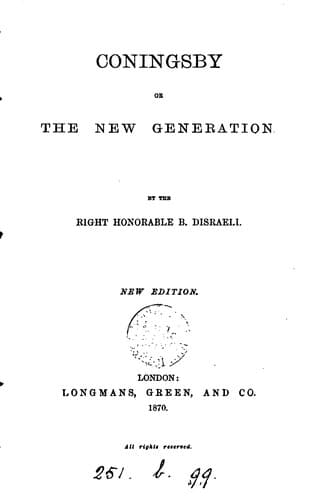
Coningsby; Or, The New GenerationDisraeli, Benjamin, Earl of Beaconsfield
General
Coningsby; Or, The New Generation
Disraeli, Benjamin, Earl of Beaconsfield
Great Britain -- Fiction; Political fiction; Politicians -- Fiction
He was just the animal that Lord Monmouth wanted, for Lord Monmouth
always looked upon human nature with the callous eye of a jockey. He
surveyed Rigby; and he determined to buy him. He bought him; with his
clear head, his indefatigable industry, his audacious tongue, and his
ready and unscrupulous pen; with all his dates, all his lampoons; all
his private memoirs, and all his political intrigues. It was a good
purchase. Rigby became a great personage, and Lord Monmouth’s man.
Mr. Rigby, who liked to be doing a great many things at the same time,
and to astonish the Tadpoles and Tapers with his energetic versatility,
determined to superintend the education of Coningsby. It was a relation
which identified him with the noble house of his pupil, or, properly
speaking, his charge: for Mr. Rigby affected rather the graceful dignity
of the governor than the duties of a tutor. The boy was recalled
from his homely, rural school, where he had been well grounded by
a hard-working curate, and affectionately tended by the curate’s
unsophisticated wife. He was sent to a fashionable school preparatory
to Eton, where he found about two hundred youths of noble families
and connections, lodged in a magnificent villa, that had once been
the retreat of a minister, superintended by a sycophantic Doctor of
Divinity, already well beneficed, and not despairing of a bishopric by
favouring the children of the great nobles. The doctor’s lady, clothed
in cashmeres, sometimes inquired after their health, and occasionally
received a report as to their linen.
Mr. Rigby had a classical retreat, not distant from this establishment,
which he esteemed a Tusculum. There, surrounded by his busts and books,
he wrote his lampoons and articles; massacred a she liberal (it was
thought that no one could lash a woman like Rigby), cut up a rising
genius whose politics were different from his own, or scarified some
unhappy wretch who had brought his claims before parliament, proving,
by garbled extracts from official correspondence that no one could refer
to, that the malcontent instead of being a victim, was, on the contrary,
a defaulter. Tadpole and Taper would back Rigby for a ‘slashing reply’
against the field. Here, too, at the end of a busy week, he found it
occasionally convenient to entertain a clever friend or two of equivocal
reputation, with whom he had become acquainted in former days of equal
brotherhood. No one was more faithful to his early friends than Mr.
Rigby, particularly if they could write a squib.
Public-domain text, read in full here on John Shaqi.
Reviews
Reviews
No reviews yet
Be the first to share your thoughts on this work.
Join the Discussion
Join the discussion
Sign in to leave a comment or review.
Sign InorCreate an account