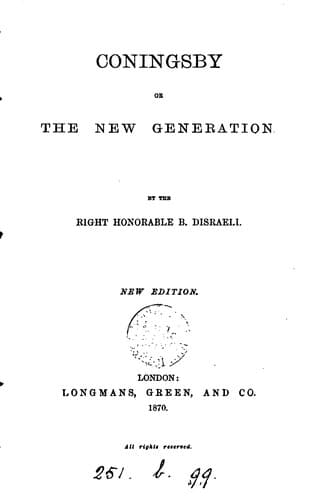
Coningsby; Or, The New GenerationDisraeli, Benjamin, Earl of Beaconsfield
General
Coningsby; Or, The New Generation
Disraeli, Benjamin, Earl of Beaconsfield
Great Britain -- Fiction; Political fiction; Politicians -- Fiction
Coningsby was not more than nine years of age when he lost his last
parent; and he had then been separated from her for nearly three years.
But he remembered the sweetness of his nursery days. His mother,
too, had written to him frequently since he quitted her, and her fond
expressions had cherished the tenderness of his heart. He wept bitterly
when his schoolmaster broke to him the news of his mother’s death. True
it was they had been long parted, and their prospect of again meeting
was vague and dim; but his mother seemed to him his only link to human
society. It was something to have a mother, even if he never saw her.
Other boys went to see their mothers! he, at least, could talk of his.
Now he was alone. His grandfather was to him only a name. Lord Monmouth
resided almost constantly abroad, and during his rare visits to England
had found no time or inclination to see the orphan, with whom he felt
no sympathy. Even the death of the boy’s mother, and the consequent
arrangements, were notified to his master by a stranger. The letter
which brought the sad intelligence was from Mr. Rigby. It was the first
time that name had been known to Coningsby.
Mr. Rigby was member for one of Lord Monmouth’s boroughs. He was the
manager of Lord Monmouth’s parliamentary influence, and the auditor of
his vast estates. He was more; he was Lord Monmouth’s companion when in
England, his correspondent when abroad; hardly his counsellor, for Lord
Monmouth never required advice; but Mr. Rigby could instruct him
in matters of detail, which Mr. Rigby made amusing. Rigby was not a
professional man; indeed, his origin, education, early pursuits, and
studies, were equally obscure; but he had contrived in good time to
squeeze himself into parliament, by means which no one could ever
comprehend, and then set up to be a perfect man of business. The world
took him at his word, for he was bold, acute, and voluble; with no
thought, but a good deal of desultory information; and though destitute
of all imagination and noble sentiment, was blessed with a vigorous,
mendacious fancy, fruitful in small expedients, and never happier than
when devising shifts for great men’s scrapes.
They say that all of us have one chance in this life, and so it was with
Rigby. After a struggle of many years, after a long series of the
usual alternatives of small successes and small failures, after a
few cleverish speeches and a good many cleverish pamphlets, with a
considerable reputation, indeed, for pasquinades, most of which he
never wrote, and articles in reviews to which it was whispered he had
contributed, Rigby, who had already intrigued himself into a subordinate
office, met with Lord Monmouth.
Public-domain text, read in full here on John Shaqi.
Reviews
Reviews
No reviews yet
Be the first to share your thoughts on this work.
Join the Discussion
Join the discussion
Sign in to leave a comment or review.
Sign InorCreate an account