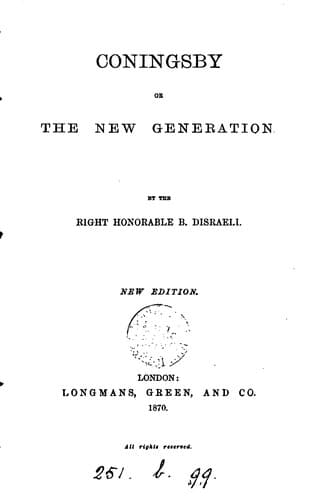
Coningsby; Or, The New GenerationDisraeli, Benjamin, Earl of Beaconsfield
General
Coningsby; Or, The New Generation
Disraeli, Benjamin, Earl of Beaconsfield
Great Britain -- Fiction; Political fiction; Politicians -- Fiction
It was certainly not without emotion that Coningsby contemplated his
first interview with his grandfather. All his experience of the ties of
relationship, however limited, was full of tenderness and rapture. His
memory often dwelt on his mother’s sweet embrace; and ever and anon a
fitful phantom of some past passage of domestic love haunted his gushing
heart. The image of his father was less fresh in his mind; but still
it was associated with a vague sentiment of kindness and joy; and the
allusions to her husband in his mother’s letters had cherished these
impressions. To notice lesser sources of influence in his estimate of
the domestic tie, he had witnessed under the roof of Beaumanoir the
existence of a family bound together by the most beautiful affections.
He could not forget how Henry Sydney was embraced by his sisters when he
returned home; what frank and fraternal love existed between his kinsman
and his elder brother; how affectionately the kind Duke had welcomed his
son once more to the house where they had both been born; and the dim
eyes, and saddened brows, and tones of tenderness, which rather looked
than said farewell, when they went back to Eton.
And these rapturous meetings and these mournful adieus were occasioned
only by a separation at the most of a few months, softened by constant
correspondence and the communication of mutual sympathy. But Coningsby
was to meet a relation, his near, almost his only, relation, for the
first time; the relation, too, to whom he owed maintenance, education;
it might be said, existence. It was a great incident for a great drama;
something tragical in the depth and stir of its emotions. Even the
imagination of the boy could not be insensible to its materials; and
Coningsby was picturing to himself a beneficent and venerable gentleman
pressing to his breast an agitated youth, when his reverie was broken by
the carriage stopping before the gates of Monmouth House.
The gates were opened by a gigantic Swiss, and the carriage rolled into
a huge court-yard. At its end Coningsby beheld a Palladian palace, with
wings and colonnades encircling the court.
A double flight of steps led into a circular and marble hall, adorned
with colossal busts of the Caesars; the staircase in fresco by Sir James
Thornhill, breathed with the loves and wars of gods and heroes. It led
into a vestibule, painted in arabesques, hung with Venetian girandoles,
and looking into gardens. Opening a door in this chamber, and proceeding
some little way down a corridor, Mr. Rigby and his companion arrived at
the base of a private staircase. Ascending a few steps, they reached a
landing-place hung with tapestry. Drawing this aside, Mr. Rigby opened a
door, and ushered Coningsby through an ante-chamber into a small saloon,
of beautiful proportions, and furnished in a brilliant and delicate
taste.
Public-domain text, read in full here on John Shaqi.
Reviews
Reviews
No reviews yet
Be the first to share your thoughts on this work.
Join the Discussion
Join the discussion
Sign in to leave a comment or review.
Sign InorCreate an account