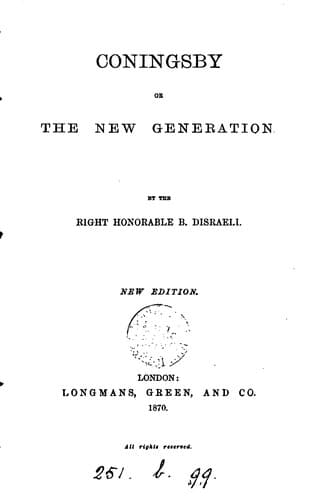
Coningsby; Or, The New GenerationDisraeli, Benjamin, Earl of Beaconsfield
General
Coningsby; Or, The New Generation
Disraeli, Benjamin, Earl of Beaconsfield
Great Britain -- Fiction; Political fiction; Politicians -- Fiction
‘You will find more to amuse you here than where you were before,’ said
Mr. Rigby, ‘and I shall not be nearly so long absent.’ So saying, he
entered into an inner apartment.
The walls of the saloon, which were covered with light blue satin, held,
in silver panels, portraits of beautiful women, painted by Boucher.
Couches and easy chairs of every shape invited in every quarter to
luxurious repose; while amusement was afforded by tables covered with
caricatures, French novels, and endless miniatures of foreign dancers,
princesses, and sovereigns.
But Coningsby was so impressed with the impending interview with his
grandfather, that he neither sought nor required diversion. Now that the
crisis was at hand, he felt agitated and nervous, and wished that he was
again at Eton. The suspense was sickening, yet he dreaded still more the
summons. He was not long alone; the door opened; he started, grew pale;
he thought it was his grandfather; it was not even Mr. Rigby. It was
Lord Monmouth’s valet.
‘Monsieur Konigby?’
‘My name is Coningsby,’ said the boy.
‘Milor is ready to receive you,’ said the valet.
Coningsby sprang forward with that desperation which the scaffold
requires. His face was pale; his hand was moist; his heart beat with
tumult. He had occasionally been summoned by Dr. Keate; that, too,
was awful work, but compared with the present, a morning visit. Music,
artillery, the roar of cannon, and the blare of trumpets, may urge a man
on to a forlorn hope; ambition, one’s constituents, the hell of previous
failure, may prevail on us to do a more desperate thing; speak in the
House of Commons; but there are some situations in life, such, for
instance, as entering the room of a dentist, in which the prostration of
the nervous system is absolute.
The moment had at length arrived when the desolate was to find a
benefactor, the forlorn a friend, the orphan a parent; when the youth,
after a childhood of adversity, was to be formally received into the
bosom of the noble house from which he had been so long estranged, and
at length to assume that social position to which his lineage entitled
him. Manliness might support, affection might soothe, the happy anguish
of such a meeting; but it was undoubtedly one of those situations
which stir up the deep fountains of our nature, and before which the
conventional proprieties of our ordinary manners instantaneously vanish.
Public-domain text, read in full here on John Shaqi.
Reviews
Reviews
No reviews yet
Be the first to share your thoughts on this work.
Join the Discussion
Join the discussion
Sign in to leave a comment or review.
Sign InorCreate an account