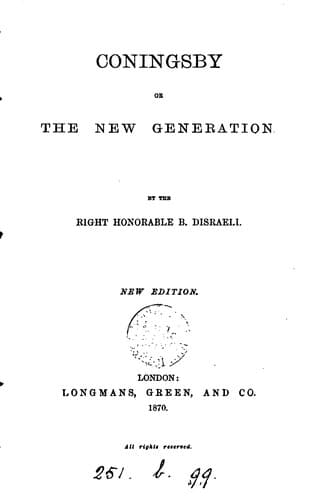
Coningsby; Or, The New GenerationDisraeli, Benjamin, Earl of Beaconsfield
General
Coningsby; Or, The New Generation
Disraeli, Benjamin, Earl of Beaconsfield
Great Britain -- Fiction; Political fiction; Politicians -- Fiction
‘Hush!’ said Mr. Rigby; ‘Lord Monmouth never likes to hear of people
who are dead; so you must take care never to mention your mother or your
father.’
In the meantime Lord Monmouth had decided on the fate of Coningsby. The
Marquis thought he could read characters by a glance, and in general
he was successful, for his natural sagacity had been nurtured by great
experience. His grandson was not to his taste; amiable no doubt, but
spooney.
We are too apt to believe that the character of a boy is easily read.
‘Tis a mystery the most profound. Mark what blunders parents constantly
make as to the nature of their own offspring, bred, too, under their
eyes, and displaying every hour their characteristics. How often in the
nursery does the genius count as a dunce because he is pensive; while a
rattling urchin is invested with almost supernatural qualities because
his animal spirits make him impudent and flippant! The school-boy, above
all others, is not the simple being the world imagines. In that young
bosom are often stirring passions as strong as our own, desires not less
violent, a volition not less supreme. In that young bosom what burning
love, what intense ambition, what avarice, what lust of power; envy that
fiends might emulate, hate that man might fear!
CHAPTER IV.
‘Come,’ said Mr. Rigby, when Coningsby was somewhat composed, ‘come with
me and we will see the house.’
So they descended once more the private staircase, and again entered the
vestibule.
‘If you had seen these gardens when they were illuminated for a fête to
George IV.,’ said Rigby, as crossing the chamber he ushered his charge
into the state apartments. The splendour and variety of the surrounding
objects soon distracted the attention of the boy, for the first time in
the palace of his fathers. He traversed saloon after saloon hung with
rare tapestry and the gorgeous products of foreign looms; filled with
choice pictures and creations of curious art; cabinets that sovereigns
might envy, and colossal vases of malachite presented by emperors.
Coningsby alternately gazed up to ceilings glowing with color and with
gold, and down upon carpets bright with the fancies and vivid with the
tints of Aubusson and of Axminster.
‘This grandfather of mine is a great prince,’ thought Coningsby, as
musing he stood before a portrait in which he recognised the features of
the being from whom he had so recently and so strangely parted. There
he stood, Philip Augustus, Marquess of Monmouth, in his robes of state,
with his new coronet on a table near him, a despatch lying at hand that
indicated the special mission of high ceremony of which he had been the
illustrious envoy, and the garter beneath his knee.
‘You will have plenty of opportunities to look at the pictures,’ said
Rigby, observing that the boy had now quite recovered himself. ‘Some
luncheon will do you no harm after our drive;’ and he opened the door of
another apartment.
Public-domain text, read in full here on John Shaqi.
Reviews
Reviews
No reviews yet
Be the first to share your thoughts on this work.
Join the Discussion
Join the discussion
Sign in to leave a comment or review.
Sign InorCreate an account