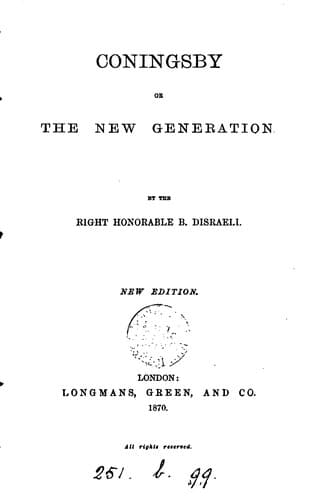
Coningsby; Or, The New GenerationDisraeli, Benjamin, Earl of Beaconsfield
General
Coningsby; Or, The New Generation
Disraeli, Benjamin, Earl of Beaconsfield
Great Britain -- Fiction; Political fiction; Politicians -- Fiction
Coningsby with an uncertain step followed his guide through a
bed-chamber, the sumptuousness of which he could not notice, into
the dressing-room of Lord Monmouth. Mr. Rigby, facing Coningsby as
he entered, was leaning over the back of a large chair, from which as
Coningsby was announced by the valet, the Lord of the house slowly rose,
for he was suffering slightly from the gout, his left hand resting on
an ivory stick. Lord Monmouth was in height above the middle size, but
somewhat portly and corpulent. His countenance was strongly marked;
sagacity on the brow, sensuality in the mouth and jaw. His head was
bald, but there were remains of the rich brown locks on which he once
prided himself. His large deep blue eye, madid and yet piercing,
showed that the secretions of his brain were apportioned, half to
voluptuousness, half to common sense. But his general mien was truly
grand; full of a natural nobility, of which no one was more sensible
than himself. Lord Monmouth was not in dishabille; on the contrary, his
costume was exact, and even careful. Rising as we have mentioned when
his grandson entered, and leaning with his left hand on his ivory cane,
he made Coningsby such a bow as Louis Quatorze might have bestowed on
the ambassador of the United Provinces. Then extending his right hand,
which the boy tremblingly touched, Lord Monmouth said:
‘How do you like Eton?’
This contrast to the reception which he had imagined, hoped, feared,
paralysed the reviving energies of young Coningsby. He felt stupefied;
he looked almost aghast. In the chaotic tumult of his mind, his memory
suddenly seemed to receive some miraculous inspiration. Mysterious
phrases heard in his earliest boyhood, unnoticed then, long since
forgotten, rose to his ear. Who was this grandfather, seen not before,
seen now for the first time? Where was the intervening link of blood
between him and this superb and icy being? The boy sank into the chair
which had been placed for him, and leaning on the table burst into
tears.
Here was a business! If there were one thing which would have made Lord
Monmouth travel from London to Naples at four-and-twenty hours’ notice,
it was to avoid a scene. He hated scenes. He hated feelings. He saw
instantly the mistake he had made in sending for his grandchild. He
was afraid that Coningsby was tender-hearted like his father. Another
tender-hearted Coningsby! Unfortunate family! Degenerate race! He
decided in his mind that Coningsby must be provided for in the Church,
and looked at Mr. Rigby, whose principal business it always was to
disembarrass his patron from the disagreeable.
Mr. Rigby instantly came forward and adroitly led the boy into the
adjoining apartment, Lord Monmouth’s bedchamber, closing the door of the
dressing-room behind him.
‘My dear young friend,’ said Mr. Rigby, ‘what is all this?’
A sob the only answer.
‘What can be the matter?’ said Mr. Rigby.
‘I was thinking,’ said Coningsby, ‘of poor mamma!’
Public-domain text, read in full here on John Shaqi.
Reviews
Reviews
No reviews yet
Be the first to share your thoughts on this work.
Join the Discussion
Join the discussion
Sign in to leave a comment or review.
Sign InorCreate an account