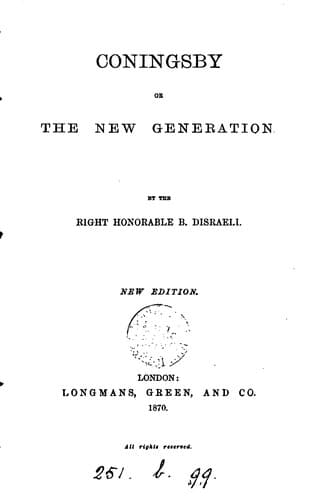
Coningsby; Or, The New GenerationDisraeli, Benjamin, Earl of Beaconsfield
General
Coningsby; Or, The New Generation
Disraeli, Benjamin, Earl of Beaconsfield
Great Britain -- Fiction; Political fiction; Politicians -- Fiction
Now in these dinners, Lucian Gay, who had brilliant conversational
powers, and who possessed all the resources of boon companionship, would
be an invaluable ally. He was therefore admitted, and inspired both
by the present enjoyment, and the future to which it might lead, his
exertions were untiring, various, most successful. Rigby’s dinners
became still, more celebrated. It, however, necessarily followed that
the guests who were charmed by Gay, wished Gay also to be their guest.
Rigby was very jealous of this, but it was inevitable; still by constant
manoeuvre, by intimations of some exercise, some day or other, of
substantial patronage in his behalf, by a thousand little arts by
which he carved out work for Gay which often prevented him accepting
invitations to great houses in the country, by judicious loans of
small sums on Lucian’s notes of hand and other analogous devices, Rigby
contrived to keep the wit in a fair state of bondage and dependence.
One thing Rigby was resolved on: Gay should never get into Monmouth
House. That was an empyrean too high for his wing to soar in. Rigby kept
that social monopoly distinctively to mark the relation that subsisted
between them as patron and client. It was something to swagger about
when they were together after their second bottle of claret. Rigby kept
his resolution for some years, which the frequent and prolonged absence
of the Marquess rendered not very difficult. But we are the creatures
of circumstances; at least the Rigby race particularly. Lord Monmouth
returned to England one year, and wanted to be amused. He wanted a
jester: a man about him who would make him, not laugh, for that was
impossible, but smile more frequently, tell good stories, say good
things, and sing now and then, especially French songs. Early in life
Rigby would have attempted all this, though he had neither fun, voice,
nor ear. But his hold on Lord Monmouth no longer depended on the mere
exercise of agreeable qualities, he had become indispensable to his
lordship, by more serious if not higher considerations. And what with
auditing his accounts, guarding his boroughs, writing him, when absent,
gossip by every post and when in England deciding on every question and
arranging every matter which might otherwise have ruffled the sublime
repose of his patron’s existence, Rigby might be excused if he shrank a
little from the minor part of table wit, particularly when we remember
all his subterranean journalism, his acid squibs, and his malicious
paragraphs, and, what Tadpole called, his ‘slashing articles.’
Public-domain text, read in full here on John Shaqi.
Reviews
Reviews
No reviews yet
Be the first to share your thoughts on this work.
Join the Discussion
Join the discussion
Sign in to leave a comment or review.
Sign InorCreate an account