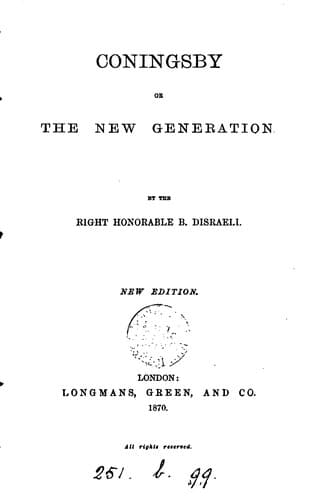
Coningsby; Or, The New GenerationDisraeli, Benjamin, Earl of Beaconsfield
General
Coningsby; Or, The New Generation
Disraeli, Benjamin, Earl of Beaconsfield
Great Britain -- Fiction; Political fiction; Politicians -- Fiction
These ‘slashing articles’ were, indeed, things which, had they appeared
as anonymous pamphlets, would have obtained the contemptuous reception
which in an intellectual view no compositions more surely deserved; but
whispered as the productions of one behind the scenes, and appearing in
the pages of a party review, they were passed off as genuine coin, and
took in great numbers of the lieges, especially in the country. They
were written in a style apparently modelled on the briefs of those sharp
attorneys who weary advocates with their clever commonplace; teasing
with obvious comment, and torturing with inevitable inference. The
affectation of order in the statement of facts had all the lucid method
of an adroit pettifogger. They dealt much in extracts from newspapers,
quotations from the _Annual Register_, parallel passages in forgotten
speeches, arranged with a formidable array of dates rarely accurate.
When the writer was of opinion he had made a point, you may be sure
the hit was in italics, that last resource of the Forcible Feebles. He
handled a particular in chronology as if he were proving an alibi at
the Criminal Court. The censure was coarse without being strong, and
vindictive when it would have been sarcastic. Now and then there was
a passage which aimed at a higher flight, and nothing can be conceived
more unlike genuine feeling, or more offensive to pure taste. And
yet, perhaps, the most ludicrous characteristic of these facetious
gallimaufreys was an occasional assumption of the high moral and
admonitory tone, which when we recurred to the general spirit of
the discourse, and were apt to recall the character of its writer,
irresistibly reminded one of Mrs. Cole and her prayer-book.
To return to Lucian Gay. It was a rule with Rigby that no one, if
possible, should do anything for Lord Monmouth but himself; and as a
jester must be found, he was determined that his Lordship should have
the best in the market, and that he should have the credit of furnishing
the article. As a reward, therefore, for many past services, and a fresh
claim to his future exertions, Rigby one day broke to Gay that the hour
had at length arrived when the highest object of reasonable ambition
on his part, and the fulfilment of one of Rigby’s long-cherished and
dearest hopes, were alike to be realised. Gay was to be presented to
Lord Monmouth and dine at Monmouth House.
The acquaintance was a successful one; very agreeable to both parties.
Gay became an habitual guest of Lord Monmouth when his patron was in
England; and in his absence received frequent and substantial marks
of his kind recollection, for Lord Monmouth was generous to those who
amused him.
Public-domain text, read in full here on John Shaqi.
Reviews
Reviews
No reviews yet
Be the first to share your thoughts on this work.
Join the Discussion
Join the discussion
Sign in to leave a comment or review.
Sign InorCreate an account