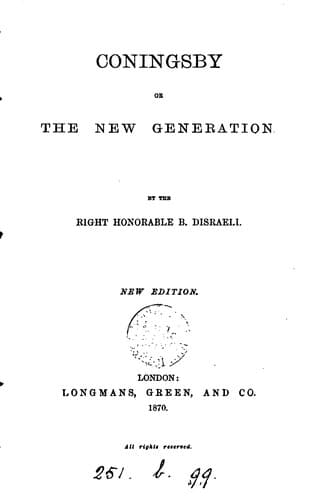
Coningsby; Or, The New GenerationDisraeli, Benjamin, Earl of Beaconsfield
General
Coningsby; Or, The New Generation
Disraeli, Benjamin, Earl of Beaconsfield
Great Britain -- Fiction; Political fiction; Politicians -- Fiction
In the meantime the hour of dinner is at hand. Coningsby, who had lost
the key of his carpet-bag, which he finally cut open with a penknife
that he found on his writing-table, and the blade of which he broke
in the operation, only reached the drawing-room as the figure of his
grandfather, leaning on his ivory cane, and following his guests,
was just visible in the distance. He was soon overtaken. Perceiving
Coningsby, Lord Monmouth made him a bow, not so formal a one as in the
morning, but still a bow, and said, ‘I hope you liked your drive.’
CHAPTER VI.
A little dinner, not more than the Muses, with all the guests clever,
and some pretty, offers human life and human nature under very
favourable circumstances. In the present instance, too, every one was
anxious to please, for the host was entirely well-bred, never selfish in
little things, and always contributed his quota to the general fund of
polished sociability.
Although there was really only one thought in every male mind present,
still, regard for the ladies, and some little apprehension of the
servants, banished politics from discourse during the greater part
of the dinner, with the occasional exception of some rapid and flying
allusion which the initiated understood, but which remained a mystery
to the rest. Nevertheless an old story now and then well told by Mr.
Ormsby, a new joke now and then well introduced by Mr. Gay, some
dashing assertion by Mr. Rigby, which, though wrong, was startling;
this agreeable blending of anecdote, jest, and paradox, kept everything
fluent, and produced that degree of mild excitation which is desirable.
Lord Monmouth sometimes summed up with an epigrammatic sentence, and
turned the conversation by a question, in case it dwelt too much on the
same topic. Lord Eskdale addressed himself principally to the ladies;
inquired after their morning drive and doings, spoke of new fashions,
and quoted a letter from Paris. Madame Colonna was not witty, but she
had that sweet Roman frankness which is so charming. The presence of
a beautiful woman, natural and good-tempered, even if she be not a
L’Espinasse or a De Stael, is animating.
Nevertheless, owing probably to the absorbing powers of the forbidden
subject, there were moments when it seemed that a pause was impending,
and Mr. Ormsby, an old hand, seized one of these critical instants to
address a good-natured question to Coningsby, whose acquaintance he had
already cultivated by taking wine with him.
‘And how do you like Eton?’ asked Mr. Ormsby.
It was the identical question which had been presented to Coningsby in
the memorable interview of the morning, and which had received no reply;
or rather had produced on his part a sentimental ebullition that had
absolutely destined or doomed him to the Church.
‘I should like to see the fellow who did not like Eton,’ said Coningsby,
briskly, determined this time to be very brave.
Public-domain text, read in full here on John Shaqi.
Reviews
Reviews
No reviews yet
Be the first to share your thoughts on this work.
Join the Discussion
Join the discussion
Sign in to leave a comment or review.
Sign InorCreate an account