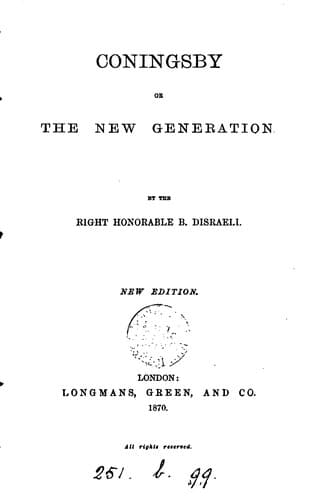
Coningsby; Or, The New GenerationDisraeli, Benjamin, Earl of Beaconsfield
General
Coningsby; Or, The New Generation
Disraeli, Benjamin, Earl of Beaconsfield
Great Britain -- Fiction; Political fiction; Politicians -- Fiction
‘Now there is a polity adapted to our laws, our institutions, our
feelings, our manners, our traditions; a polity capable of great ends
and appealing to high sentiments; a polity which, in my opinion, would
render government an object of national affection, which would terminate
sectional anomalies, assuage religious heats, and extinguish Chartism.’
‘You said to me yesterday,’ said Millbank after a pause, ‘quoting the
words of another, which you adopted, that Man was made to adore and to
obey. Now you have shown to me the means by which you deem it possible
that government might become no longer odious to the subject; you have
shown how man may be induced to obey. But there are duties and interests
for man beyond political obedience, and social comfort, and national
greatness, higher interests and greater duties. How would you deal
with their spiritual necessities? You think you can combat political
infidelity in a nation by the principle of enlightened loyalty; how
would you encounter religious infidelity in a state? By what means is
the principle of profound reverence to be revived? How, in short, is man
to be led to adore?’
‘Ah! that is a subject which I have not forgotten,’ replied Coningsby.
‘I know from your letters how deeply it has engaged your thoughts.
I confess to you that it has often filled mine with perplexity and
depression. When we were at Eton, and both of us impregnated with the
contrary prejudices in which we had been brought up, there was still
between us one common ground of sympathy and trust; we reposed with
confidence and affection in the bosom of our Church. Time and thought,
with both of us, have only matured the spontaneous veneration of our
boyhood. But time and thought have also shown me that the Church of our
heart is not in a position, as regards the community, consonant with its
original and essential character, or with the welfare of the nation.’
‘The character of a Church is universality,’ replied Millbank. ‘Once
the Church in this country was universal in principle and practice; when
wedded to the State, it continued at least universal in principle, if
not in practice. What is it now? All ties between the State and
the Church are abolished, except those which tend to its danger and
degradation.
Public-domain text, read in full here on John Shaqi.
Reviews
Reviews
No reviews yet
Be the first to share your thoughts on this work.
Elsewhere in the archive
Join the Discussion
Join the discussion
Sign in to leave a comment or review.
Sign InorCreate an account