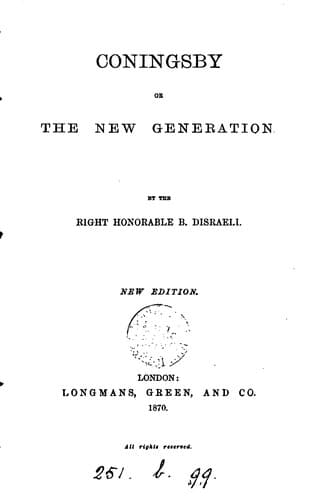
Coningsby; Or, The New GenerationDisraeli, Benjamin, Earl of Beaconsfield
General
Coningsby; Or, The New Generation
Disraeli, Benjamin, Earl of Beaconsfield
Great Britain -- Fiction; Political fiction; Politicians -- Fiction
‘What can be more anomalous than the present connection between State
and Church? Every condition on which it was originally consented to
has been cancelled. That original alliance was, in my view, an equal
calamity for the nation and the Church; but, at least, it was an
intelligible compact. Parliament, then consisting only of members of
the Established Church, was, on ecclesiastical matters, a lay synod, and
might, in some points of view, be esteemed a necessary portion of Church
government. But you have effaced this exclusive character of Parliament;
you have determined that a communion with the Established Church shall
no longer be part of the qualification for sitting in the House of
Commons. There is no reason, so far as the constitution avails, why
every member of the House of Commons should not be a dissenter. But the
whole power of the country is concentrated in the House of Commons.
The House of Lords, even the Monarch himself, has openly announced and
confessed, within these ten years, that the will of the House of Commons
is supreme. A single vote of the House of Commons, in 1832, made the
Duke of Wellington declare, in the House of Lords, that he was obliged
to abandon his sovereign in “the most difficult and distressing
circumstances.” The House of Commons is absolute. It is the State.
“L’Etat c’est moi.” The House of Commons virtually appoints the bishops.
A sectarian assembly appoints the bishops of the Established Church.
They may appoint twenty Hoadleys. James II was expelled the throne
because he appointed a Roman Catholic to an Anglican see. A Parliament
might do this to-morrow with impunity. And this is the constitution in
Church and State which Conservative dinners toast! The only consequences
of the present union of Church and State are, that, on the side of the
State, there is perpetual interference in ecclesiastical government, and
on the side of the Church a sedulous avoidance of all those principles
on which alone Church government can be established, and by the
influence of which alone can the Church of England again become
universal.’
‘But it is urged that the State protects its revenues?’
Public-domain text, read in full here on John Shaqi.
Reviews
Reviews
No reviews yet
Be the first to share your thoughts on this work.
Elsewhere in the archive
Join the Discussion
Join the discussion
Sign in to leave a comment or review.
Sign InorCreate an account