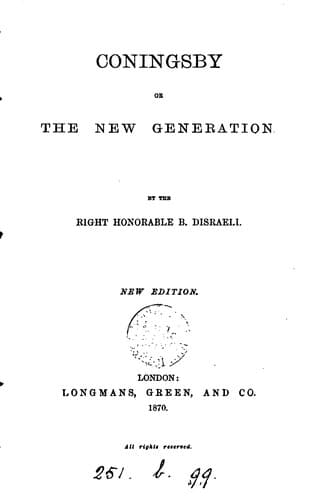
Coningsby; Or, The New GenerationDisraeli, Benjamin, Earl of Beaconsfield
General
Coningsby; Or, The New Generation
Disraeli, Benjamin, Earl of Beaconsfield
Great Britain -- Fiction; Political fiction; Politicians -- Fiction
‘I wonder how he will form his cabinet,’ said Lord Monmouth; ‘the old
story won’t do.’
‘I hear that Baring is to be one of the new cards; they say it will
please the city,’ said Lord Eskdale. ‘I suppose they will pick out
of hedge and ditch everything that has ever had the semblance of
liberalism.’
‘Affairs in my time were never so complicated,’ said Mr. Ormsby.
‘Nay, it appears to me to lie in a nutshell,’ said Lucian Gay; ‘one
party wishes to keep their old boroughs, and the other to get their new
peers.’
CHAPTER VII.
The future historian of the country will be perplexed to ascertain what
was the distinct object which the Duke of Wellington proposed to himself
in the political manoeuvres of May, 1832. It was known that the passing
of the Reform Bill was a condition absolute with the King; it was
unquestionable, that the first general election under the new law must
ignominiously expel the Anti-Reform Ministry from power; who would then
resume their seats on the Opposition benches in both Houses with the
loss not only of their boroughs, but of that reputation for political
consistency, which might have been some compensation for the
parliamentary influence of which they had been deprived. It is difficult
to recognise in this premature effort of the Anti-Reform leader to
thrust himself again into the conduct of public affairs, any indications
of the prescient judgment which might have been expected from such a
quarter. It savoured rather of restlessness than of energy; and, while
it proved in its progress not only an ignorance on his part of the
public mind, but of the feelings of his own party, it terminated
under circumstances which were humiliating to the Crown, and painfully
significant of the future position of the House of Lords in the new
constitutional scheme.
The Duke of Wellington has ever been the votary of circumstances. He
cares little for causes. He watches events rather than seeks to produce
them. It is a characteristic of the military mind. Rapid combinations,
the result of quick, vigilant, and comprehensive glance, are generally
triumphant in the field: but in civil affairs, where results are
not immediate; in diplomacy and in the management of deliberative
assemblies, where there is much intervening time and many counteracting
causes, this velocity of decision, this fitful and precipitate action,
are often productive of considerable embarrassment, and sometimes of
terrible discomfiture. It is remarkable that men celebrated for military
prudence are often found to be headstrong statesmen. In civil life
a great general is frequently and strangely the creature of impulse;
influenced in his political movements by the last snatch of information;
and often the creature of the last aide-de-camp who has his ear.
Public-domain text, read in full here on John Shaqi.
Reviews
Reviews
No reviews yet
Be the first to share your thoughts on this work.
Join the Discussion
Join the discussion
Sign in to leave a comment or review.
Sign InorCreate an account