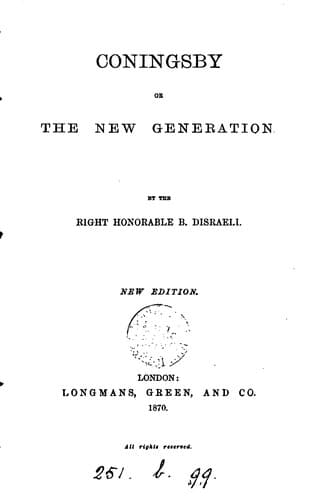
Coningsby; Or, The New GenerationDisraeli, Benjamin, Earl of Beaconsfield
General
Coningsby; Or, The New Generation
Disraeli, Benjamin, Earl of Beaconsfield
Great Britain -- Fiction; Political fiction; Politicians -- Fiction
We shall endeavour to trace in another chapter the reasons which on
this as on previous and subsequent occasions, induced Sir Robert Peel to
stand aloof, if possible, from official life, and made him reluctant
to re-enter the service of his Sovereign. In the present instance, even
temporary success could only have been secured by the utmost decision,
promptness, and energy. These were all wanting: some were afraid to
follow the bold example of their leader; many were disinclined. In
eight-and-forty hours it was known there was a ‘hitch.’
The Reform party, who had been rather stupefied than appalled by the
accepted mission of the Duke of Wellington, collected their scattered
senses, and rallied their forces. The agitators harangued, the mobs
hooted. The City of London, as if the King had again tried to seize the
five members, appointed a permanent committee of the Common Council to
watch the fortunes of the ‘great national measure,’ and to report daily.
Brookes’, which was the only place that at first was really frightened
and talked of compromise, grew valiant again; while young Whig heroes
jumped upon club-room tables, and delivered fiery invectives. Emboldened
by these demonstrations, the House of Commons met in great force, and
passed a vote which struck, without disguise, at all rival powers in the
State; virtually announced its supremacy; revealed the forlorn position
of the House of Lords under the new arrangement; and seemed to lay for
ever the fluttering phantom of regal prerogative.
It was on the 9th of May that Lord Lyndhurst was with the King, and on
the 15th all was over. Nothing in parliamentary history so humiliating
as the funeral oration delivered that day by the Duke of Wellington
over the old constitution, that, modelled on the Venetian, had governed
England since the accession of the House of Hanover. He described his
Sovereign, when his Grace first repaired to his Majesty, as in a
state of the greatest ‘difficulty and distress,’ appealing to his
never-failing loyalty to extricate him from his trouble and vexation.
The Duke of Wellington, representing the House of Lords, sympathises
with the King, and pledges his utmost efforts for his Majesty’s
relief. But after five days’ exertion, this man of indomitable will and
invincible fortunes, resigns the task in discomfiture and despair, and
alleges as the only and sufficient reason for his utter and hopeless
defeat, that the House of Commons had come to a vote which ran counter
to the contemplated exercise of the prerogative.
From that moment power passed from the House of Lords to another
assembly. But if the peers have ceased to be magnificoes, may it
not also happen that the Sovereign may cease to be a Doge? It is not
impossible that the political movements of our time, which seem on
the surface to have a tendency to democracy, may have in reality a
monarchical bias.
Public-domain text, read in full here on John Shaqi.
Reviews
Reviews
No reviews yet
Be the first to share your thoughts on this work.
Join the Discussion
Join the discussion
Sign in to leave a comment or review.
Sign InorCreate an account