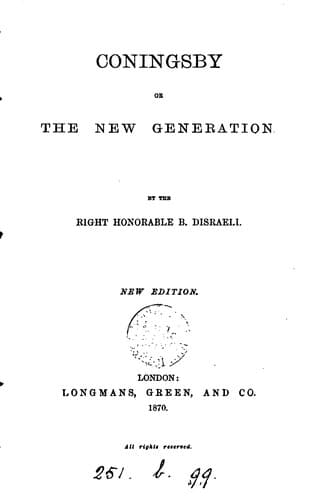
Coningsby; Or, The New GenerationDisraeli, Benjamin, Earl of Beaconsfield
General
Coningsby; Or, The New Generation
Disraeli, Benjamin, Earl of Beaconsfield
Great Britain -- Fiction; Political fiction; Politicians -- Fiction
In treating the House of the Third Estate as the House of the People,
and not as the House of a privileged class, the Ministry and Parliament
of 1831 virtually conceded the principle of Universal Suffrage. In this
point of view the ten-pound franchise was an arbitrary, irrational, and
impolitic qualification. It had, indeed, the merit of simplicity, and so
had the constitutions of Abbé Siéyès. But its immediate and inevitable
result was Chartism.
But if the Ministry and Parliament of 1831 had announced that the time
had arrived when the Third Estate should be enlarged and reconstructed,
they would have occupied an intelligible position; and if, instead of
simplicity of elements in its reconstruction, they had sought, on the
contrary, various and varying materials which would have neutralised the
painful predominance of any particular interest in the new scheme, and
prevented those banded jealousies which have been its consequences, the
nation would have found itself in a secure condition. Another class not
less numerous than the existing one, and invested with privileges not
less important, would have been added to the public estates of the
realm; and the bewildering phrase ‘the People’ would have remained,
what it really is, a term of natural philosophy, and not of political
science.
During this eventful week of May, 1832, when an important revolution
was effected in the most considerable of modern kingdoms, in a manner
so tranquil, that the victims themselves were scarcely conscious at
the time of the catastrophe, Coningsby passed his hours in unaccustomed
pleasures, and in novel excitement. Although he heard daily from the
lips of Mr. Rigby and his friends that England was for ever lost, the
assembled guests still contrived to do justice to his grandfather’s
excellent dinners; nor did the impending ruin that awaited them
prevent the Princess Colonna from going to the Opera, whither she
very good-naturedly took Coningsby. Madame Colonna, indeed, gave such
gratifying accounts of her dear young friend, that Coningsby became
daily a greater favourite with Lord Monmouth, who cherished the idea
that his grandson had inherited not merely the colour of his eyes, but
something of his shrewd and fearless spirit.
Public-domain text, read in full here on John Shaqi.
Reviews
Reviews
No reviews yet
Be the first to share your thoughts on this work.
Join the Discussion
Join the discussion
Sign in to leave a comment or review.
Sign InorCreate an account